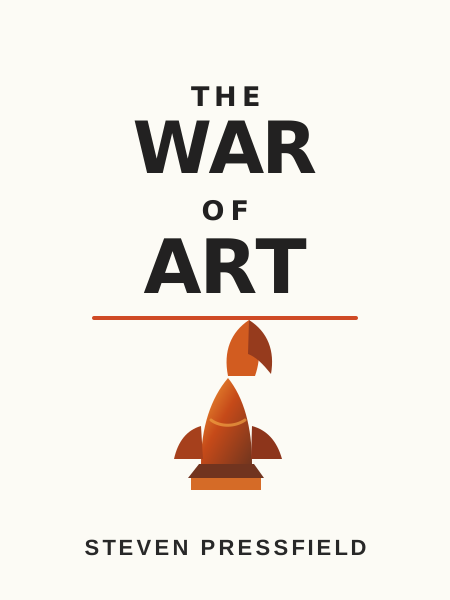
The War of Art
Steven Pressfield · 2002
Editorial rating
- Evidence
- 5/10
- Actionability
- 9/10
- Originality
- 8/10
The thesis
Every creative act is opposed by an internal force Pressfield calls "Resistance" - that voice of procrastination, self-doubt, fear, and rationalization that keeps you from doing your work. Resistance is universal, relentless, and invisible. The only way to defeat it is to "turn pro" - to show up every day and do the work regardless of how you feel.
Who this is for
Writers staring at blank pages, artists who've abandoned projects, entrepreneurs paralyzed by fear, and anyone whose best creative work remains locked inside them because they keep finding reasons not to start.
My favorite quote
Most of us have two lives. The life we live, and the unlived life within us. Between the two stands Resistance.
Why it matters
This names the gap between who we are and who we could be - and identifies the enemy blocking the path.
Do this
What's the creative project you've been avoiding? Name the Resistance. Then do 15 minutes of work on it today. Not tomorrow. Today.
Start here
The more important the work, the more Resistance you'll feel: Resistance isn't random - it's proportional. If you feel massive Resistance toward a project, that's a signal it matters to your soul. The fear is a compass pointing toward exactly what you need to do.
Critical summary
Pressfield, a novelist who struggled for decades before success, personifies the internal obstacles to creative work as "Resistance" with a capital R. The book is divided into three parts: defining Resistance, combating it by "turning pro," and connecting to higher creative forces.
What it gets right
- Naming Resistance makes an invisible enemy visible and fightable
- "Turning pro" mindset is simple and powerful
- Short chapters make it easy to pick up when you need a push
- Doesn't coddle - it's tough love that many creatives need
- Widely beloved (Tim Ferriss, Seth Godin, Robert McKee endorse it)
What it misses
- Part Three on muses and angels alienates secular readers
- Some claims are extreme (Hitler's creative block caused WWII)
- Dismisses mental health conditions as forms of Resistance - harmful and wrong
- No evidence or research - pure personal philosophy
- Can feel preachy and absolutist
Evidence is entirely anecdotal and philosophical. Not a science book - it's a manifesto.
Key concepts
Resistance
The universal force that opposes any creative or self-improvement act. Invisible, internal, relentless, and proportional to importance.
Turning Pro
The mindset shift from amateur (works when inspired) to professional (works regardless of inspiration).
The Amateur vs. The Professional
Amateurs overidentify with their work and are paralyzed by fear of failure. Pros show up every day regardless.
The Muse
Pressfield's term for the creative force that arrives when you sit down to do the work. Shows up after you start, not before.
Shadow Career
The safe career you pursue instead of your true calling.
Territorial vs. Hierarchical
Pros work for the territory (the work itself) not the hierarchy (external validation).
Core insights
-
Resistance is strongest at the finish line
Don't relax when you're close to done. That's when Resistance gets sneakiest.
-
Fear is a compass
The more scared you are of a work, the more certain you can be that you have to do it.
-
Pros don't wait for inspiration
They sit down and start. Inspiration follows commitment, not the other way around.
-
Resistance never goes away
You don't defeat it once - you defeat it every day, every session.
-
Amateurs overidentify with their work
If your self-worth is tied to the outcome, you'll be paralyzed. Detachment enables action.
-
The work wants to be done
You're not creating something from nothing - you're channeling something that wants to exist.
Implementation steps
Today
- Name your Resistance. What creative work are you avoiding?
- Do 15 minutes of that work. Not tomorrow. Now.
This week
- Commit to a daily minimum (word count, time block, page count)
- Show up every day regardless of how you feel
This month
- Complete one project you've been avoiding
- Identify your "shadow career" - the safe thing you're doing instead of your calling
Ongoing
- Treat your creative work as a job. Same time, same place, every day.
- When Resistance shows up (it always will), recognize it and work anyway.
Suggested 30-day practice plan
An editorial application plan created by Monolithic Vault - an interpretation of the book's ideas, not part of the original book.
- Day 1
List every project you've abandoned due to Resistance
- Day 2
Pick one. Commit to 15 minutes daily for 30 days.
- Day 3
Show up. Don't judge the output. Just show up.
- Day 7
Notice Resistance's tactics this week. How did it try to stop you?
- Day 14
Increase your daily minimum by 10%
- Day 21
Reflect: Has the Muse started showing up?
- Day 30
You've turned pro for 30 days. What's next?
Free PDF summary
Take this analysis with you: a designed two-page field-notes sheet with the thesis, my favorite quote, the key concepts and core insights, and the full 30-day checklist. Print it or keep it - free, no signup.
Go deeper
If this analysis earned your attention, the full book goes further than any summary can. The original is always the primary source.