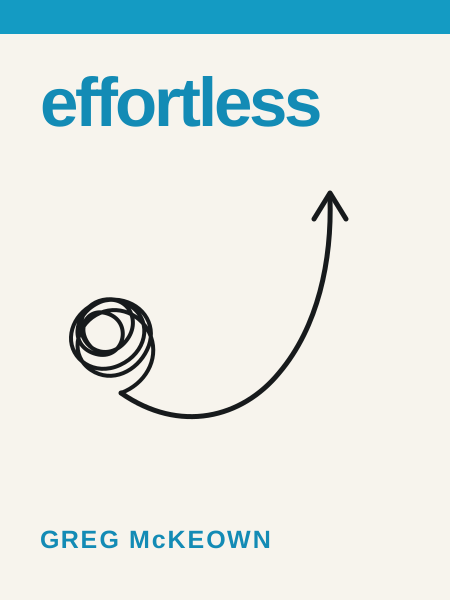

Effortless
Greg McKeown · 2021
Editorial rating
- Evidence
- 7/10
- Actionability
- 9/10
- Originality
- 7/10
The thesis
Not everything has to be a grind. When we hit a wall, our instinct is to push harder, but high performance often comes from finding the Effortless Way. By simplifying the process, removing emotional clutter, and automating the essential, we can achieve more by doing less.
Who this is for
Overachievers on the edge of burnout, managers dealing with complex projects that feel "stuck," and anyone who believes that if it isn't hard, it isn't valuable.
My favorite quote
If you over-complicate the easy, you make the essential impossible.
Why it matters
It highlights our tendency to add unnecessary friction to our most important work.
Do this
Identify your most important task. Ask: "How could this be easy?" Strip away every step that isn't strictly necessary.
Start here
Adopt the Effortless State. This is a physical and mental state of relaxation and focus. Before starting any complex task, clear your "mental clutter" - grudges, worries about the future, or the need for perfection. If the task feels too heavy, you are likely carrying unnecessary baggage or over-complicating the outcome.
Critical summary
McKeown builds on his previous work (Essentialism) by shifting focus from what we do to how we do it. While Essentialism was about doing the right things, Effortless is about doing those things in the right way - without the exhaustive strain we’ve been conditioned to expect.
He breaks the book into three parts:
- Effortless State: Clearing the mind of reactive emotions.
- Effortless Action: Simplifying the work itself (Definition, Simplification, Progress).
- Effortless Results: Creating systems that work for you while you sleep (Automation, Trust, Prevention).
What it gets right
- The concept of "Inversion": Asking "What if this was easy?" is a powerful mental model.
- The "Upper Limit" rule: Setting a daily ceiling for effort to prevent the "boom and bust" cycle.
- Focus on "Residual Results": Building systems that continue to pay off after the initial effort is spent.
Key concepts
The Effortless State
A state of low mental friction.
The Upper Limit
Deciding on a daily maximum (e.g., "I will write at least 500 words but no more than 1,000").
Automation
Shifting from one-off actions to perpetual systems.
Done as a Definition
Precisely defining what "finished" looks like before you start to prevent feature creep.
Implementation steps
Today
- Define Done: For your current project, write down exactly what the finish line looks like in one sentence.
- The 2-Minute Reset: If you feel stressed, stop for two minutes and list 5 things you are grateful for. Gratitude resets the nervous system into an effortless state.
This week
- Simplify the First Step: For the task you're avoiding, break the first step down until it feels "ludicrously easy."
- Set an Upper Limit: Choose a recurring task and set a "do not exceed" time or output limit.
Suggested 30-day practice plan
An editorial application plan created by Monolithic Vault - an interpretation of the book's ideas, not part of the original book.
- Day 1
Audit your "Residual Results." What systems do you have that work while you're not there?
- Day 10
Identify one "one-time effort" that will yield "perpetual results" (e.g., creating a template).
- Day 30
Review your progress. Are you still grinding, or have you found the effortless pace?
Free PDF summary
Take this analysis with you: a designed two-page field-notes sheet with the thesis, my favorite quote, the key concepts and core insights, and the full 30-day checklist. Print it or keep it - free, no signup.
Go deeper
If this analysis earned your attention, the full book goes further than any summary can. The original is always the primary source.