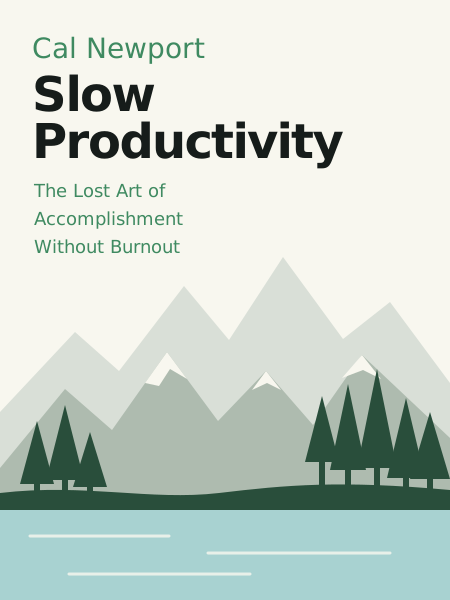
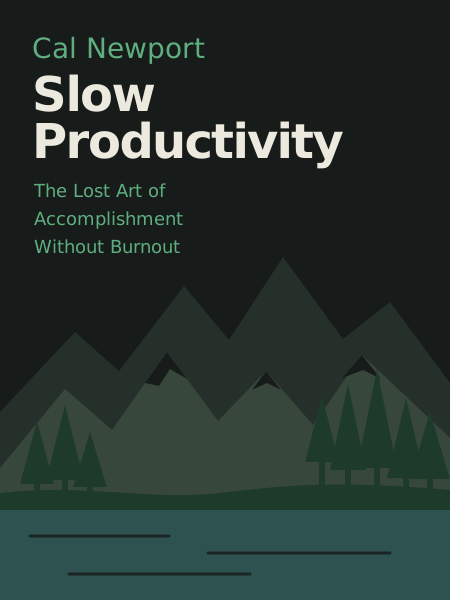
Slow Productivity
Cal Newport · 2024
Editorial rating
- Evidence
- 6/10
- Actionability
- 6/10
- Originality
- 7/10
The thesis
Pseudo-productivity - measuring output by visible busyness - is making knowledge workers miserable and mediocre. True productivity requires doing fewer things, working at a natural pace, and obsessing over quality. The goal isn't more tasks completed but meaningful work sustained over years.
Who this is for
Knowledge workers drowning in email, meetings, and shallow tasks who have some autonomy over their workload. Writers, researchers, consultants, and professionals who produce artifacts (documents, code, analyses) rather than just attending meetings.
My favorite quote
We've defaulted to using visible activity as a proxy for useful effort, creating a culture where people feel they need to seem busy, even if this busyness is preventing them from accomplishing useful work.
Why it matters
This names the disease most knowledge workers feel but can't articulate. The problem isn't time management - it's that the system rewards performance of productivity over actual output.
Do this
Count how many active projects/commitments you have right now. If it's more than three major ones, you have a prioritization problem, not a time management problem.
Start here
Do Fewer Things: Limit active projects to three. Not three categories of work - three actual projects with clear endpoints. This creates the cognitive space to do any of them well. When everything is priority one, nothing gets the sustained attention that quality requires. The productivity gains from focus dramatically outweigh what you lose by saying no.
Critical summary
Newport argues that modern knowledge work has no coherent definition of productivity, so organizations default to "visible busyness" as proxy. This pseudo-productivity - answering emails fast, filling calendars, appearing overwhelmed - actively prevents meaningful output.
His alternative rests on three principles: do fewer things, work at a natural pace (including seasonal variation and breaks), and obsess over quality rather than quantity. He draws heavily on examples of historical knowledge workers (writers, scientists, artists) who produced great work through patient, focused effort over years.
What it gets right
- Diagnosis of pseudo-productivity resonates deeply with burned-out knowledge workers
- "Natural pace" concept acknowledges human energy fluctuates (daily, weekly, seasonally)
- Quality obsession reframes success from output volume to craft
- Historical examples provide aspirational alternative to always-on culture
What it misses
- Assumes worker autonomy that most employees don't have (try telling your boss you're only doing three things)
- Doesn't adequately address how to convince organizations to measure output over years not weeks
- Examples heavily skewed toward privileged creative professionals (tenured professors, successful authors)
- Retreads Deep Work concepts without much new practical guidance
- Limited advice for those whose jobs genuinely require reactive availability
Evidence is primarily historical anecdotes and Newport's personal experience. The principles are philosophically sound but lack the tactical specificity of his earlier work.
Key concepts
Pseudo-Productivity
Using visible busyness as proxy for useful work. Notice when you're performing productivity vs. actually producing.
Pull-Based Workflow
Instead of accepting all incoming requests, pull new work only when capacity exists. Stop saying yes to everything.
Natural Pace
Work intensity should vary - intense periods followed by recovery. Plan quarterly, not just weekly.
Seasonality
Creative output isn't linear. Some months are for production, others for input and recovery.
Obsess Over Quality
Slow down to do fewer things excellently rather than many things adequately.
Core insights
-
Busyness and productivity are inversely correlated
The more things you juggle, the less you accomplish on any of them. Context-switching destroys depth.
-
Your best work takes years, not weeks
The mental model of "productivity" should be measured across years, not daily task completion.
-
Workload isn't imposed - it's accepted
Most overwork comes from saying yes to requests that seem small individually but compound into impossible loads.
-
Recovery isn't optional
Historical creative producers built in extensive downtime. The "always working" modern professional is historically aberrant.
-
Quality creates its own efficiency
Excellent work compounds (reputation, opportunities, influence) in ways that adequate work doesn't.
Implementation steps
Today
- List all active projects and commitments (be exhaustive)
- Identify which three actually matter most
This week
- Decline or defer two commitments that aren't in your top three
- Block two 2-hour periods for deep work on your #1 project
- Turn off email notifications on phone
This month
- Implement a pull-based system: maintain a waiting queue for new requests
- Take one full day completely offline
- Define what "excellent" looks like for your main project
Ongoing
- Review active projects weekly, maintain limit of three major ones
- Plan quarterly cycles with varying intensity (production vs. recovery periods)
- Audit commitments monthly, prune aggressively
Suggested 30-day practice plan
An editorial application plan created by Monolithic Vault - an interpretation of the book's ideas, not part of the original book.
- Day 1
Complete full inventory of current commitments across all areas
- Day 2
Rank projects by impact, identify top three
- Day 3
Draft "no" responses for three low-priority requests you've been avoiding
- Day 7
Establish morning deep work block (2+ hours, no email/meetings)
- Day 14
Take a full "slow day" - no new inputs, just processing existing work
- Day 21
Review: Are you actually doing fewer things? What crept back in?
- Day 30
Design next quarter with intentional variation in intensity
Free PDF summary
Take this analysis with you: a designed two-page field-notes sheet with the thesis, my favorite quote, the key concepts and core insights, and the full 30-day checklist. Print it or keep it - free, no signup.
Go deeper
If this analysis earned your attention, the full book goes further than any summary can. The original is always the primary source.