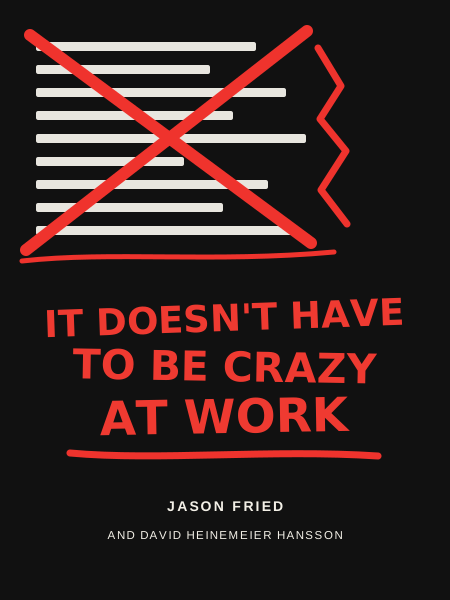
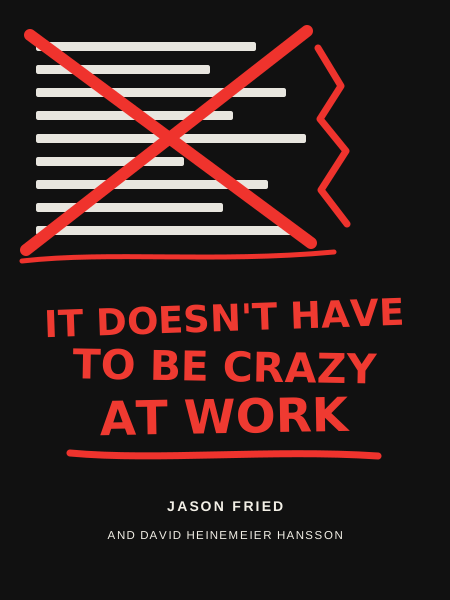
It Doesn't Have to Be Crazy at Work
Jason Fried & David Heinemeier Hansson · 2018
Editorial rating
- Evidence
- 5/10
- Actionability
- 7/10
- Originality
- 7/10
The thesis
The chaos of modern work isn't inevitable - it's a choice. Companies choose to create environments of constant interruption, unrealistic deadlines, and performative busyness. Basecamp has proven for two decades that calm companies can be successful companies. You can build a great business without burning people out.
Who this is for
Founders tired of the "hustle porn" startup culture, managers watching their teams burn out, and anyone who suspects there's a better way to work but doesn't have permission to try it.
My favorite quote
Calm is protecting people's time and attention. Calm is about 40 hours of work a week. Calm is reasonable expectations. Calm is ample time off.
Why it matters
This defines calm concretely - it's not laziness; it's sustainable productivity.
Do this
This week, decline one meeting that isn't essential. See what happens.
Start here
Implement library rules for your office or remote work: Default to silence, not interruption. Treat people's time and attention as the scarce resources they are. Chat and email are asynchronous by default - responses aren't expected instantly. Real-time communication is for emergencies, not everyday work.
Critical summary
Fried and Hansson, founders of Basecamp (formerly 37signals), wrote this manifesto against toxic work culture. They argue that the chaos we accept as normal - the packed calendars, Slack pings, and performative overwork - is a design flaw, not a law of nature.
The book is organized as short, punchy chapters making specific arguments: Don't track hours, track quality. 40 hours is enough. Meetings should be rare. ASAP is poison. Benefits should be real (not foosball tables). The tone is confident, occasionally smug.
What it gets right
- The critique of performative busyness is spot-on
- Concrete practices from a real company (not abstract principles)
- Challenges toxic startup norms without apologizing
- Short, readable chapters make it easy to extract ideas
- Permission-granting for leaders who want to try something different
What it misses
- Basecamp is a small, bootstrapped company - not all advice scales
- Can feel preachy and self-righteous
- Doesn't address externally imposed chaos (client demands, investor pressure)
- Light on implementation; more manifesto than manual
- Some ideas are more applicable to software companies than other industries
- Later controversies at Basecamp complicated the "calm company" narrative
Best used for permission and ideas, not as a complete operating system.
Key concepts
Calm Company
A company that protects time, attention, and wellbeing. Not slow; sustainable.
Library Rules
Default to silence. Interruptions should be rare, not constant. Offices (and Slack) should be quiet.
Office Hours
Instead of constant availability, set specific times when people can ask you questions.
JOMO (Joy of Missing Out)
You don't need to be in every meeting, on every thread, aware of everything. Missing out is fine.
Enough
A radical concept - at some point, you have enough profit, enough growth, enough market share. Stop chasing more.
No Goals
Basecamp doesn't set annual goals. Goals create false urgency and distort behavior. Just do good work.
Core insights
-
Crazy is a choice
Most workplace chaos is self-inflicted. Companies choose packed calendars, constant availability, and unrealistic deadlines.
-
40 hours is enough
If you can't do great work in 40 hours, you have a prioritization problem, not a time problem.
-
ASAP is poison
When everything is urgent, nothing is. Real emergencies are rare; treat them that way.
-
Your company is not a family
Families don't fire people. Call it what it is - a business relationship - and treat people accordingly.
-
Calm enables deep work
Knowledge work requires focus. Constant interruption isn't a productivity hack; it's productivity poison.
Implementation steps
Today
- Turn off non-essential notifications for 4 hours; notice the calm
- Identify one standing meeting that could be an async update
This week
- Implement "office hours" for yourself - specific times people can interrupt, protected time when they can't
- Audit your team's meeting load; cancel the most useless one
This month
- Establish library rules: set expectations for response times that allow deep work
- Pilot a "no meeting day" once a week
Ongoing
- Default to async communication; reserve real-time for true emergencies
- Question every new meeting: Could this be an email?
Suggested 30-day practice plan
An editorial application plan created by Monolithic Vault - an interpretation of the book's ideas, not part of the original book.
- Day 1
Audit your notification settings; disable anything non-essential
- Day 2
Cancel one recurring meeting that isn't adding value
- Day 3
Establish personal "office hours" and communicate them
- Day 7
Pilot "library rules" with your team for one day
- Day 14
Implement a no-meeting day; protect it aggressively
- Day 21
Review your calendar: How much time is protected for actual work?
- Day 30
Assess the experiment: Is the team more productive? Less stressed?
Free PDF summary
Take this analysis with you: a designed two-page field-notes sheet with the thesis, my favorite quote, the key concepts and core insights, and the full 30-day checklist. Print it or keep it - free, no signup.
Go deeper
If this analysis earned your attention, the full book goes further than any summary can. The original is always the primary source.