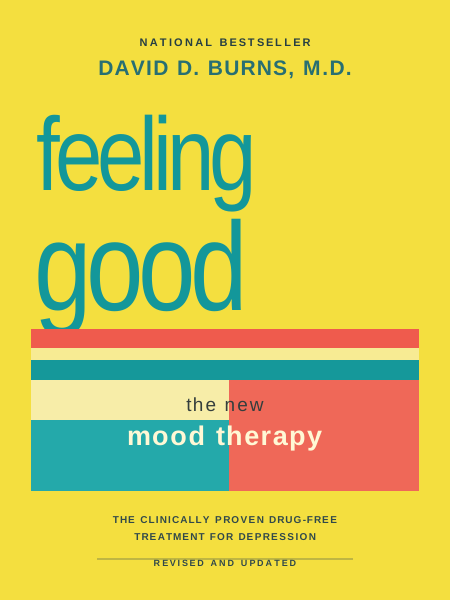
Feeling Good
David D. Burns · 1980
Editorial rating
- Evidence
- 9/10
- Actionability
- 10/10
- Originality
- 8/10
The thesis
Depression is not caused by bad events - it's caused by distorted thinking about events. By identifying and challenging cognitive distortions systematically, you can change your emotional state without medication for mild-to-moderate depression.
Who this is for
People with mild-to-moderate depression or persistent negative thought patterns who want evidence-based, practical tools. Not a replacement for therapy or medication in severe cases, but powerful self-help for many.
My favorite quote
You can learn to change the way you think about things, and you can also change your basic values and beliefs. And when you do, you will often experience profound and lasting changes in your mood, outlook, and productivity.
Why it matters
Offers agency over mental health through cognitive work, not passive waiting for mood to lift.
Do this
Write down your next negative thought verbatim. Identify which of the 10 cognitive distortions it contains. Write a rational response.
Start here
Learn the 10 Cognitive Distortions and you'll spot them everywhere: All-or-Nothing Thinking, Overgeneralization, Mental Filter, Disqualifying Positives, Jumping to Conclusions, Magnification, Emotional Reasoning, Should Statements, Labeling, Personalization. Most depression involves 3-4 of these running on autopilot. Name them, challenge them, replace them. Works for 70% of people with depression (studies show equal efficacy to medication for mild-moderate cases).
Critical summary
Burns, a Stanford psychiatrist, popularized cognitive behavioral therapy (CBT) for mass audiences. The core framework: depression stems from systematic errors in thinking. By learning to identify these errors and develop rational responses, people can lift depression without medication.
The book's greatest strength is specificity and structure. Where most self-help offers platitudes, Burns provides: (1) clear taxonomy of distortions, (2) step-by-step written exercises, (3) concrete examples with dialogue, (4) mood tracking to measure progress. The "Daily Mood Log" alone is worth the price.
What it gets right
- Evidence-based approach (CBT has strongest research support in psychology)
- Actionable exercises you can start today
- Focus on thoughts as separate from self - creates distance
- Mood tracking creates accountability and shows progress
- Works for many without therapy or medication
What it misses
- CBT helps mild-moderate depression, not severe/clinical cases
- Can feel victim-blaming ("just think differently")
- Minimal discussion of trauma, bipolar, or chemical depression
- Dated gender/relationship examples (1980 publication)
- May create guilt if it doesn't work ("I'm too broken even for this")
- Heteronormative examples throughout
Evidence: CBT has 40+ years of research showing efficacy comparable to medication for mild-moderate depression. Burns' specific techniques have been validated across hundreds of studies. Reddit consensus: "Changed my life" or "Helpful but needs supplementing with therapy."
Criticism: Works best for specific anxiety/depression types. Less effective for trauma, personality disorders, or severe cases. Some therapists note patients can use it to intellectualize rather than feel.
Key concepts
Cognitive Distortion
Systematic error in thinking that creates negative emotion. Learn to spot in real-time and challenge.
Automatic Thoughts
Rapid, believable thoughts that pop up unbidden. Usually distorted. Must slow down to catch them.
Triple-Column Technique
Write automatic thought | identify distortion | write rational response. Physical writing is key - thinking alone doesn't work.
All-or-Nothing Thinking
Seeing things in black-and-white. "I got a B, therefore I'm a failure." Devastating and common.
Should Statements
Using "should," "must," "ought" creates guilt and resentment. Replace with preferences.
Daily Mood Log
Track depression/anxiety levels daily. Seeing improvement motivates continued practice.
Core insights
-
Feelings follow thoughts, not events
Two people experience same failure - one is devastated, one is fine. The difference is thought pattern, not circumstance.
-
You cannot control feelings directly
Trying to "just be happy" fails. Change thoughts, feelings follow. Indirect route is only route.
-
Perfection is man's ultimate illusion
Everything can be improved, so perfectionists are guaranteed misery. Excellence is achievable; perfection is not.
-
Depression is not realistic
Depressed people think they see clearly. They don't - they see through distorted lens that focuses only on negatives.
-
Achievements bring satisfaction, not happiness
Pursuing achievements to feel worthwhile creates endless treadmill. Worthwhile ≠ accomplished.
Implementation steps
Today
- Buy a notebook for Daily Mood Log (paper > digital for this work)
- Write down one automatic negative thought word-for-word
- Identify which cognitive distortion(s) it contains using the list
This week
- Use Triple-Column Technique daily: automatic thought | distortion | rational response
- Track mood 1-10 scale morning and evening
- Challenge one "should" statement: replace with "it would be preferable if..."
This month
- Complete Daily Mood Log every day for 30 days (research shows this alone helps 40%)
- Identify your top 3 recurring distortions - these are your vulnerabilities
- Practice "vertical arrow technique" to find core beliefs driving distortions
Ongoing
- When mood drops, ask: "What was I just thinking?" Catch automatic thoughts in real-time.
- Maintain mood log indefinitely - becomes early warning system
- Revisit common distortions monthly - they recur under stress
Suggested 30-day practice plan
An editorial application plan created by Monolithic Vault - an interpretation of the book's ideas, not part of the original book.
- Day 1
Learn the 10 cognitive distortions. Print list and keep visible.
- Day 2
Start Daily Mood Log - rate depression 0-10, anxiety 0-10
- Day 3
Practice Triple-Column Technique with one negative thought
- Day 7
Review week's logs. Notice patterns in thinking and mood fluctuation.
- Day 14
Identify your top 3 distortions. These are your defaults under stress.
- Day 21
Challenge one core belief using vertical arrow technique
- Day 30
Compare Day 1 vs Day 30 mood scores. Most see 30-50% improvement.
Free PDF summary
Take this analysis with you: a designed two-page field-notes sheet with the thesis, my favorite quote, the key concepts and core insights, and the full 30-day checklist. Print it or keep it - free, no signup.
Go deeper
If this analysis earned your attention, the full book goes further than any summary can. The original is always the primary source.