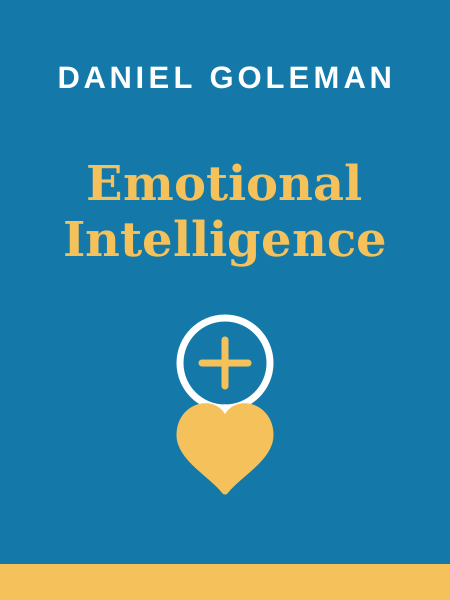
Emotional Intelligence
Daniel Goleman · 1995
Editorial rating
- Evidence
- 4/10
- Actionability
- 5/10
- Originality
- 6/10
The thesis
Success in life depends as much on emotional competencies - self-awareness, self-regulation, motivation, empathy, and social skills - as on cognitive intelligence. These skills can be developed, and neglecting them has personal and societal costs.
Who this is for
Technical professionals who wonder why less "smart" colleagues advance faster, managers who need to navigate office politics and difficult conversations, and anyone whose career has stalled despite strong technical skills.
My favorite quote
Anyone can become angry - that is easy. But to be angry with the right person, to the right degree, at the right time, for the right purpose, and in the right way - this is not easy.
Why it matters
Aristotle's quote (which Goleman cites) captures the essence of emotional intelligence: emotions aren't the enemy - mismanaged emotions are.
Do this
Next time you feel a strong emotion, pause and ask: Is this the right intensity for this situation? Right target?
Start here
Practice emotional labeling: When you feel something, name it specifically. Not "I feel bad" but "I feel anxious because this presentation might reveal gaps in my knowledge." Neuroscience shows that naming emotions reduces their intensity by activating the prefrontal cortex. This single practice builds the foundation for all other EQ skills.
Critical summary
Goleman, a science journalist (not a psychologist), synthesized emerging research on emotional processing and social skills into a compelling narrative that challenged IQ's monopoly on predicting success. The book launched EQ into the mainstream vocabulary.
What it gets right
- The core premise is valid: social and emotional skills matter for outcomes
- Self-awareness as a foundational skill is well-supported
- The "amygdala hijack" concept - emotions overwhelming rational thought - is useful and memorable
- Goleman rightly argues that emotional skills can be developed
What it misses or overstates
- The claim that EQ matters more than IQ for success is not supported by evidence - Goleman himself later walked this back
- "EQ" as a measurable intelligence is scientifically controversial; it may just be personality traits repackaged
- The concept has become so broad it includes almost anything that's not IQ
- No standardized, validated way to measure EQ (unlike IQ tests)
- Heavy overlap with conscientiousness and agreeableness from Big Five personality research
- The "80% of success is EQ" claim is a myth that Goleman has disavowed
Evidence quality: Weak by scientific standards. Goleman is a journalist synthesizing research, not a researcher presenting original findings. The scientific originators of EQ (Salovey and Mayer) are critical of how Goleman expanded and commercialized the concept. Jordan Peterson has called EQ "a fraudulent concept" because it doesn't meet the criteria for being an intelligence. Best treated as a useful heuristic rather than rigorous science.
Key concepts
Self-Awareness
Recognizing your emotions as they occur and understanding their impact. The foundation of all other EQ skills.
Self-Regulation
Managing disruptive emotions and impulses. Not suppression, but appropriate expression.
Motivation
Internal drive beyond external rewards. Optimism and commitment to goals despite setbacks.
Empathy
Sensing others' emotions and perspectives. Necessary for influence and leadership.
Social Skills
Managing relationships and building networks. Influence, conflict resolution, collaboration.
Amygdala Hijack
When the emotional brain overrides the rational brain, causing impulsive reactions you regret.
Core insights
-
IQ gets you hired; EQ gets you promoted
Technical competence is table stakes. Advancement requires navigating relationships and managing yourself under pressure.
-
Emotions contain information
Feelings like anxiety or frustration are signals worth examining, not noise to suppress. What is the emotion telling you?
-
Self-awareness precedes self-management
You can't regulate what you don't notice. Start by increasing emotional granularity - specific naming.
-
Empathy is skill, not just personality
You can deliberately practice perspective-taking and emotional attunement. It's effortful but learnable.
-
Emotional contagion is real
Moods spread. Leaders especially set emotional tone for teams. Your state affects others' performance.
Implementation steps
Today
- Track emotions for one day: Set 3 phone alarms to prompt "What am I feeling right now? Why?" Record answers.
- Identify one relationship where you're emotionally reactive; commit to a 6-second pause before responding
This week
- Practice "name it to tame it": When emotionally activated, label the specific emotion out loud or in writing
- In one meeting, focus entirely on reading others' nonverbal cues rather than formulating your next point
This month
- Map your emotional triggers: Which situations reliably produce strong reactions? What's the underlying pattern?
- Practice empathic listening: In conversations, reflect back what you hear ("It sounds like you're feeling...")
Ongoing
- After conflicts, review: What was I feeling? What were they feeling? What did I miss in the moment?
- Build emotional vocabulary - move beyond "good/bad/stressed" to specific labels (frustrated, anxious, disappointed, overwhelmed)
Suggested 30-day practice plan
An editorial application plan created by Monolithic Vault - an interpretation of the book's ideas, not part of the original book.
- Day 1
Rate yourself 1-10 on each of the five EQ domains; identify your weakest area
- Day 2
Start an emotion log - track 3 emotions per day with context and intensity (1-10)
- Day 3
Practice the 6-second pause before responding emotionally (one cortical loop)
- Day 7
Ask a trusted colleague for feedback on how you come across emotionally
- Day 14
Review your emotion log for patterns - what triggers you consistently?
- Day 21
Practice empathic reflection in 5 conversations; note what you learn
- Day 30
Re-rate yourself on the five domains; create development plan for weakest area
Free PDF summary
Take this analysis with you: a designed two-page field-notes sheet with the thesis, my favorite quote, the key concepts and core insights, and the full 30-day checklist. Print it or keep it - free, no signup.
Go deeper
If this analysis earned your attention, the full book goes further than any summary can. The original is always the primary source.