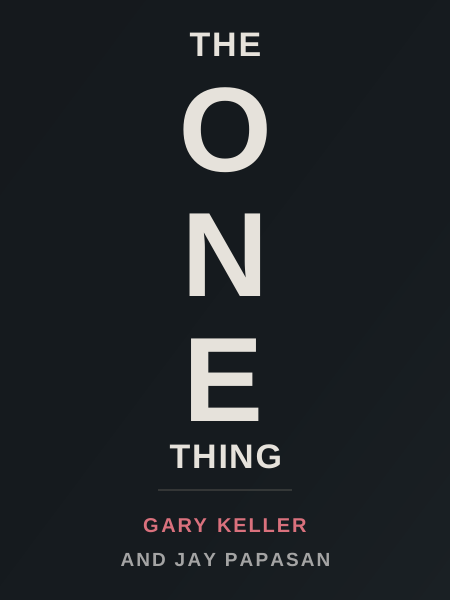
The One Thing
Gary Keller · 2013
Editorial rating
- Evidence
- 7/10
- Actionability
- 9/10
- Originality
- 8/10
The thesis
Extraordinary results are directly determined by how narrow you can make your focus. Success is sequential, not simultaneous: you must line up your priorities like dominoes and knock down the single "lead domino" that makes everything else easier or unnecessary.
Who this is for
Entrepreneurs drowning in "good" opportunities, multitasking managers who feel busy but ineffective, and anyone who feels their daily to-do list is disconnected from their long-term goals.
My favorite quote
What is the ONE Thing I can do such that by doing it everything else will be easier or unnecessary?
Why it matters
It is the ultimate filtering mechanism. It forces you to identify the lead domino rather than just "getting things done."
Do this
Before starting work today, look at your list and ask this question. Circle that one task. Do it first.
Start here
Use the Focusing Question ("What is the ONE Thing...") at two levels: 1. Macro (Vision): "What is the ONE Thing I want to do with my life?" 2. Micro (Daily): "What is the ONE Thing I can do right now to get on track for my weekly goal?" Then, Time Block 4 hours a day for your ONE Thing. Protect this time with your life. If you don't time block it, it won't happen.
Critical summary
Gary Keller argues that the old adage "don't put all your eggs in one basket" is wrong. To achieve mastery, you must put all your eggs in one basket and watch that basket. The book attacks the modern myths of productivity: that everything matters equally, that multitasking works, and that you need a "balanced" life (you don't; you need counter-balance).
What it gets right
- The Domino Effect: It visualizes success perfectly. A 2-inch domino can knock over a 3-inch domino. By the 18th domino, you can knock over the Leaning Tower of Pisa. Small, focused action compounds.
- Willpower is a Battery: Keller correctly identifies that willpower depletes. Do your most important work early, before your "battery" drains.
- The "Success List": A to-do list is a "survival list." A success list is short, prioritized, and uncomfortable.
What it misses
- The 4-Hour Standard: Suggesting "4 hours of deep work a day" is unrealistic for most corporate employees who don't own their own company (like Keller does).
- Complexity: Real life is rarely just "one thing." While the philosophy is sound for growth, it ignores the "maintenance" work (email, admin) that keeps a career alive.
- Repetition: The book stretches a single (brilliant) concept into 240 pages. The core value is in the first 50 pages.
Key concepts
The Focusing Question
"What is the ONE Thing I can do such that by doing it everything else will be easier or unnecessary?"
The Domino Effect
Geometric progression of success. You don't need to knock over the big goal today; you just need to knock over the lead domino that points to it.
Time Blocking
The only way to get the ONE Thing done. Block time (ideally 4 hours) as an appointment with yourself.
The 6 Lies of Success
The 4 Thieves of Productivity
(1) Inability to say "No," (2) Fear of Chaos, (3) Poor Health Habits, (4) Environment doesn't support your goals.
Core insights
-
Success is sequential, not simultaneous
You cannot build a wall all at once. You lay one brick perfectly, then the next.
-
Multitasking is a lie
It is actually "switch-tasking," and every switch costs you time and IQ points.
-
Willpower has a battery life
It is highest in the morning and lowest after lunch. Never schedule your ONE Thing for 4:00 PM.
-
Balance is a myth
To achieve extraordinary results, you must get out of balance. You "counter-balance" by going deep into work for periods, then swinging back to family/health. You cannot be in the middle.
-
Chaos is guaranteed
When you focus on ONE Thing, other things will fall apart (messy desk, unread emails). You must get comfortable with this chaos to succeed.
Implementation steps
Today
- The Garbage Purge: Look at your to-do list. Cross out 80% of items that are "could do" but not "should do."
- The Battery Check: Reschedule your most cognitive task to 8:00 AM - 10:00 AM.
This week
- The Bunker Strategy: Find a physical place where no one can find you for 2 hours. Go there to work on your ONE Thing.
- Notification blackout: Turn off ALL notifications during your time block. Phone in another room.
This month
- The "No" Campaign: Say "No" to 3 requests that do not align with your ONE Thing.
- Habit Install: Focus on ONE habit (e.g., gym) for 66 days (the average time to build a habit). Do not try to build 5 habits at once.
Ongoing
- Sunday Planning: Every Sunday, look at your yearly goals and ask: "What is the ONE Thing I can do this week to stay on track?"
- The 4-Hour Block: Gradually work up to a 4-hour daily time block for your most important work.
Suggested 30-day practice plan
An editorial application plan created by Monolithic Vault - an interpretation of the book's ideas, not part of the original book.
- Day 1
Identify your "Someday" goal and work backward to your "Today" ONE Thing.
- Day 2
Block 1 hour for your ONE Thing. (Start small).
- Day 3
Practice the "Focusing Question" before checking email.
- Day 7
Review your week: Did you knock over the lead domino?
- Day 14
Increase time block to 2 hours.
- Day 21
Audit your environment. Does your desk distract you? Fix it.
- Day 30
Evaluate: Have you moved the needle on your ONE Thing? If not, is it the wrong thing, or did you not protect the time?
Free PDF summary
Take this analysis with you: a designed two-page field-notes sheet with the thesis, my favorite quote, the key concepts and core insights, and the full 30-day checklist. Print it or keep it - free, no signup.
Go deeper
If this analysis earned your attention, the full book goes further than any summary can. The original is always the primary source.