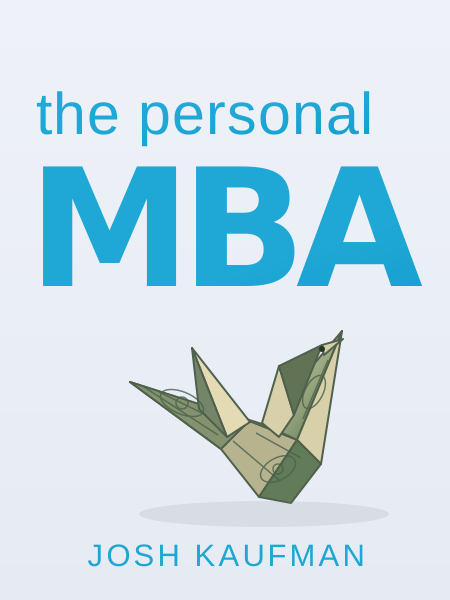
The Personal MBA
Josh Kaufman · 2010
Editorial rating
- Evidence
- 5/10
- Actionability
- 7/10
- Originality
- 4/10
The thesis
You don't need a $150,000 MBA to understand business. The essential concepts underlying every successful business - value creation, marketing, sales, delivery, and finance - can be learned through focused self-study, saving you years of time and hundreds of thousands of dollars.
Who this is for
Entrepreneurs who need business fundamentals without the credential, career changers exploring whether business school is worth the investment, and professionals who want a comprehensive mental map of how businesses actually work.
My favorite quote
The MBA system selects for people with money, not necessarily people with talent.
Why it matters
Challenges the assumption that business school equals business capability. The credential often signals resources, not competence.
Do this
Before pursuing formal education, ask: What specific skill gap am I trying to fill? Could I learn it faster and cheaper through focused self-study?
Start here
Every business relies on five interdependent processes: Value Creation (producing something people want), Marketing (getting attention and building demand), Sales (turning prospects into paying customers), Value Delivery (giving customers what you promised), and Finance (ensuring the math works). If any of these five break down, the business fails. Use this as your diagnostic lens for any business problem - which of the five is broken?
Critical summary
Josh Kaufman wrote this book after concluding that MBA programs waste time and money for most people. His alternative: a synthesis of core business concepts drawn from his reading of hundreds of business books, distilled into the essential mental models anyone needs to understand commerce.
What it gets right
The book provides a genuinely comprehensive overview of business. It covers topics from pricing psychology to systems thinking to personal productivity, all in accessible language without jargon. For someone new to business, this offers a useful map of the territory.
The five-process framework (Value Creation → Marketing → Sales → Value Delivery → Finance) is simple and correct. Kaufman avoids the case-study approach of traditional business education, focusing instead on transferable principles that apply across industries.
The book works as a reference. Each concept is explained briefly with practical applications. You can dip in and out for specific topics without reading cover to cover.
What it misses
The "replacement for an MBA" positioning overstates the case. This book teaches concepts; business school provides connections, structured practice, recruiting access, and credentials that matter for certain career paths. It's not an either/or choice.
Much of the content rehashes established ideas without adding new insights. Readers familiar with business literature will find few surprises. The 80/20 principle, AIDA model, and similar concepts have been explained elsewhere, often better.
The synthesis lacks depth. Complex topics (finance, strategy, organizational behavior) get surface-level treatment. You'll know terms exist but not how to actually implement sophisticated approaches. This is an index to business knowledge, not a substitute for deeper study.
Critics also note Kaufman lacks formal business credentials - his authority comes from reading books, not running large organizations. This doesn't invalidate the content, but limits practical insights.
Key concepts
The Five Parts of Every Business
Value Creation, Marketing, Sales, Value Delivery, Finance. Use as a diagnostic framework when something's not working.
The Iron Law of the Market
The size of your opportunity is limited by the number of people willing to pay. Even great products fail in markets that don't exist.
Relative Importance Testing
Understand what customers actually value most, not what they say they value. Rank features by what people will pay for.
Incremental Degradation
Systems fail slowly, then suddenly. Monitor leading indicators before catastrophic failure.
Parkinson's Law
Work expands to fill the time available. Set shorter deadlines to force efficiency.
Core insights
-
Every business is fundamentally simple
Strip away complexity and all businesses create value, market it, sell it, deliver it, and count the money. Master these five, and you understand business.
-
Customers don't buy products; they buy better versions of themselves
Marketing succeeds when it connects your offer to the person's desired identity or outcome.
-
Price is a positioning signal
Low prices attract price-sensitive customers who are often the hardest to serve. Higher prices can attract better customers and create premium perception.
-
Satisfied customers are not enough
You need customers who actively recommend you. The gap between "satisfied" and "enthusiastic" is where referrals live.
-
Your brain is for having ideas, not storing them
Build external systems to capture and organize information. Free your mind for creative work.
Implementation steps
Today
- Audit a business you interact with using the five-part framework: Where are they strong? Where weak?
- List the three most valuable concepts you want to learn more deeply
This week
- Read one chapter from Kaufman's recommended reading list in your weakest area
- Apply one pricing or marketing concept to something you're currently working on
This month
- Build a personal knowledge management system for capturing business insights
- Teach one concept from this book to a colleague (teaching is the best learning)
Ongoing
- Maintain a reading habit: 30-40 business books over 2-3 years equals MBA-level exposure
- Apply concepts immediately; knowledge without application is just entertainment
Suggested 30-day practice plan
An editorial application plan created by Monolithic Vault - an interpretation of the book's ideas, not part of the original book.
- Day 1
Read Part 1 (Value Creation). Identify one opportunity to create value in your current role or side project.
- Day 2
Read Part 2 (Marketing). Write a one-sentence hook for something you want to promote.
- Day 3
Read Part 3 (Sales). Practice overcoming one common objection you face.
- Day 7
Complete reading. Identify your weakest of the five areas.
- Day 14
Deep dive into your weakest area. Read one additional book from Kaufman's recommendations.
- Day 21
Apply three concepts in real situations. Document what worked and what didn't.
- Day 30
Create a personal reading plan: Which 10 books will you read in the next 6 months? Schedule time weekly for business education.
Free PDF summary
Take this analysis with you: a designed two-page field-notes sheet with the thesis, my favorite quote, the key concepts and core insights, and the full 30-day checklist. Print it or keep it - free, no signup.
Go deeper
If this analysis earned your attention, the full book goes further than any summary can. The original is always the primary source.