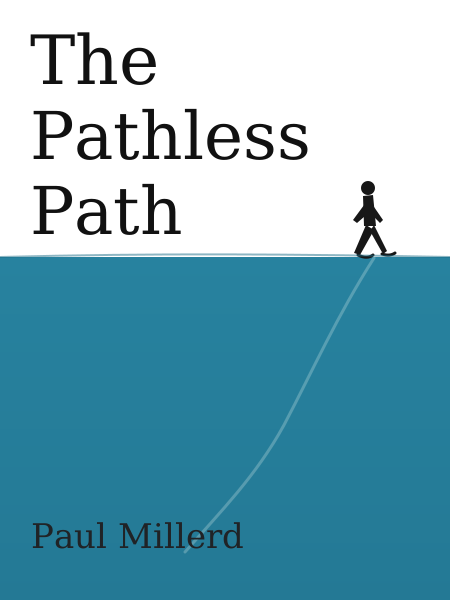
The Pathless Path
Paul Millerd · 2022
Editorial rating
- Evidence
- 5/10
- Actionability
- 7/10
- Originality
- 6/10
The thesis
The "default path" of prestigious jobs, steady promotions, and conventional success often leads to emptiness. The alternative - a "pathless path" - means designing work around life rather than life around work, prioritizing fulfillment over status, and prototyping your way to a meaningful career rather than following a script.
Who this is for
High-achievers feeling trapped in prestigious but unfulfilling careers, burned-out professionals questioning the default script, and anyone considering leaving traditional employment for self-directed work.
My favorite quote
Instead of thinking about what you want to do with your life, you default to the options most admired by your peers. This is the trap of prestigious career paths.
Why it matters
This captures how social proof hijacks our career decisions. We chase impressive-sounding paths without asking if they actually fit us.
Do this
List your next three career decisions. For each, write whether you want it or whether it's admired by your peers.
Start here
Prototype Your Leap: Don't quit your job to follow your passion - prototype it first. Test what your life might look like through small experiments, side projects, and conversations before making irreversible decisions. Millerd's own path involved years of "pragmatic and safe experiments" before fully committing.
Critical summary
Paul Millerd, a former McKinsey consultant, documents his journey from the "default path" to a self-directed life of writing, consulting, and digital creation. The book blends memoir with synthesis of ideas from Naval Ravikant, Derek Sivers, and others on alternative approaches to work.
The central framework contrasts the Default Path (prestigious credentials, corporate ladder, delayed fulfillment) with the Pathless Path (self-directed work, immediate meaning, unconventional choices). Millerd argues that the internet has made the pathless path more viable than ever.
What it gets right
- Articulates the quiet desperation many high-achievers feel
- "Prototype your leap" is genuinely useful advice
- Acknowledges uncertainty rather than promising easy answers
- Curates good ideas from diverse sources
What it misses
- Survivorship bias looms large - failed pathless paths are invisible
- Privilege is underacknowledged (McKinsey salary enables runway)
- Core message isn't revolutionary - echoes 4-Hour Workweek updated for 2020s
- Light on concrete frameworks; heavy on personal narrative
The book resonates deeply with a certain audience but offers more permission than prescription. Evidence is primarily Millerd's own experience and curated examples.
Key concepts
The Default Path
The conventional script of school → prestigious job → ladder climbing → retirement. Safe-seeming but often soul-crushing.
The Pathless Path
Self-directed work without predetermined destination. Requires embracing uncertainty and designing your own experiments.
Fixed Points
Non-negotiable goals we pursue without questioning whether they're actually ours. Usually inherited from culture or peers.
Enough
The threshold of money, status, and security that enables contentment. Most people never define it and therefore never reach it.
Prototype Your Leap
Test unconventional paths through small experiments before committing. Reduces risk and builds conviction.
Long-Term Games
Investments (relationships, skills, reputation) that compound over decades. The pathless path favors these over short-term wins.
Core insights
-
Default paths are defaults, not requirements
The conventional script exists because it's legible and safe, not because it's optimal for your life.
-
Prestige is a trap
We chase options admired by peers rather than options that fit us. This is socially safe but personally dangerous.
-
The internet changes everything
Geographic freedom, audience access, and income diversification make unconventional paths more viable than ever.
-
Uncertainty is the price of freedom
The pathless path offers no guarantees. That's a feature, not a bug - but only if you have appropriate risk tolerance.
-
Find your "enough"
Without defining what's sufficient, you'll optimize forever and never arrive.
Implementation steps
Today
- Define your "enough" - how much money, status, and security would be sufficient?
- Identify one thing you're pursuing because peers admire it, not because you want it
This week
- Have one conversation with someone living an unconventional career path
- List three small experiments you could run to test a different kind of work
This month
- Start one prototype project: a side project, freelance gig, or creative experiment
- Track your energy levels across different work activities
Ongoing
- Regularly audit whether you're on the default path or your path
- Build long-term games: relationships, skills, and assets that compound
Suggested 30-day practice plan
An editorial application plan created by Monolithic Vault - an interpretation of the book's ideas, not part of the original book.
- Day 1
Write your current "default path" trajectory - where does it lead in 10 years?
- Day 2
Define your personal "enough" in money, time, and status
- Day 3
Identify one fixed point you've inherited but never questioned
- Day 7
Have a conversation with someone on an unconventional path
- Day 14
Launch one small prototype experiment
- Day 21
Journal about what you've learned from your prototype
- Day 30
Decide: continue default path, modify it, or begin planning your leap?
Free PDF summary
Take this analysis with you: a designed two-page field-notes sheet with the thesis, my favorite quote, the key concepts and core insights, and the full 30-day checklist. Print it or keep it - free, no signup.
Go deeper
If this analysis earned your attention, the full book goes further than any summary can. The original is always the primary source.