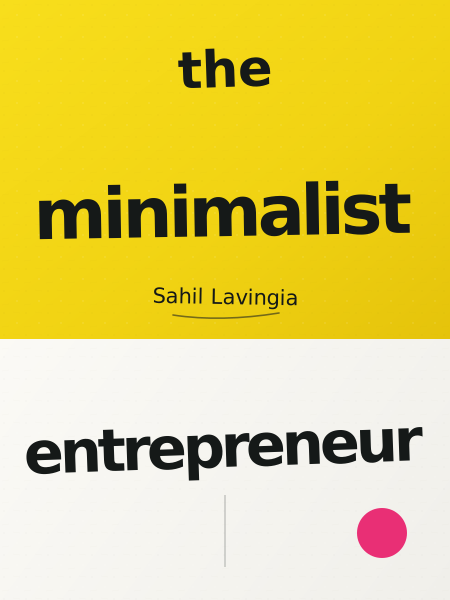
The Minimalist Entrepreneur
Sahil Lavingia · 2021
Editorial rating
- Evidence
- 7/10
- Actionability
- 8/10
- Originality
- 6/10
The thesis
You don't need venture capital, a huge team, or a decade of runway to build a meaningful business. Start with a community you're part of, solve a real problem for them, and grow profitably from day one. The minimalist approach isn't about settling - it's about building sustainable companies that serve both you and your customers.
Who this is for
Aspiring founders intimidated by the VC-funded startup narrative, creators looking to monetize their communities, and exhausted entrepreneurs who've been chasing growth at all costs and want a different path.
My favorite quote
Profitability means sustainability. Instead of treading water until a lifeboat comes along to save you - which is how many founders think about raising their next round of VC funding - it means building your own boat.
Why it matters
The VC path optimizes for growth, not survival. Profitability-first gives you optionality: you can choose to raise money, sell, or keep running indefinitely.
Do this
Calculate your "default alive" runway: how long until you're profitable at current growth? If it's never, something needs to change now.
Start here
Start with community, not product. Find a group you already belong to, understand their problems deeply, and build something they'd pay for. This flips the traditional startup script: instead of "build it and they will come," it's "know them and build what they need." Your community provides feedback, early customers, and distribution - all before you write a line of code.
Critical summary
Sahil Lavingia built Gumroad into a multi-million dollar business, but not before nearly killing it with VC-fueled growth ambitions. After laying off most of his team and downsizing to a one-person company, he discovered a better path: profitable, sustainable, and fulfilling. This book codifies those hard-won lessons.
The minimalist entrepreneur framework follows a logical progression: become part of a community, identify problems worth solving, build a manual solution first, productize it, sell to your first 100 customers, market by educating, hire mindfully, and grow sustainably. It's a rejection of blitzscaling in favor of thoughtful, profitable growth.
What it gets right
- Honest about the pain of chasing unicorn status - Lavingia lived the failure mode
- Practical, step-by-step framework for community-first building
- Strong emphasis on profitability as freedom, not limitation
- Examples from Gumroad's creator economy make concepts concrete
What it misses
- Over-generalizes from SaaS/creator economy context - less applicable to other business types
- The "find your community" advice assumes communities are sitting around waiting for solutions
- Can feel prescriptive - Lavingia's path may not be everyone's path
- Limited discussion of failure modes within the minimalist approach
Evidence comes primarily from Gumroad's journey plus examples from the creator economy. The advice is battle-tested but context-dependent.
Key concepts
Community-First Building
Start by contributing to a community, then solve their problems. Distribution comes built-in.
Manual Before Automated
Refine a valuable manual process before building software. This validates the problem before you invest in the solution.
Profitability Over Growth
Being profitable from day one gives you leverage and sustainability that funded startups don't have.
Educate, Don't Sell
Marketing is teaching. Help people understand their problems, and the sales follow naturally.
Goldilocks Community
Find a community that's big enough to sustain you, small enough to serve deeply, and underserved by larger players.
Minimalist Hiring
Hire only when the pain of not hiring exceeds the cost of hiring. Keep the team lean and autonomous.
Core insights
-
VC funding is a choice, not a requirement
Most successful businesses never raise venture capital. The minimalist path is available to anyone.
-
Your community is your distribution
Building in public, contributing before asking, and solving real problems creates organic growth that paid marketing can't match.
-
Go manual before you automate
Spreadsheets, emails, and manual processes prove value. Premature automation wastes engineering time on unvalidated ideas.
-
Charge money from day one
Free users don't validate anything. The willingness to pay is the only real evidence that you're solving a valuable problem.
-
Growth mindfully, not mindlessly
Scale when you're ready, not because investors demand it. Sustainable growth beats explosive growth followed by implosion.
Implementation steps
Today
- List 3 communities you're genuinely part of (not just lurking in)
- Identify the top 3 complaints or frustrations you've seen in each
This week
- Offer to solve one person's problem manually - no product, just help
- Ask 5 community members: "What's the most frustrating part of [X]?"
This month
- Build a "manual MVP": solve the problem using existing tools (spreadsheets, email, etc.)
- Get 5 people to pay you for this manual service
Ongoing
- Only automate what's been validated manually
- Track profitability monthly; never sacrifice it for growth metrics
Suggested 30-day practice plan
An editorial application plan created by Monolithic Vault - an interpretation of the book's ideas, not part of the original book.
- Day 1
Audit your communities - where do you have real credibility and relationships?
- Day 2
Interview 5 community members about their biggest pain points
- Day 3
Choose one problem; sketch a manual solution
- Day 7
Offer your manual solution to 3 people; deliver it personally
- Day 14
Get your first paying customer (even if it's $20)
- Day 21
Document your process; identify what could be automated
- Day 30
Decide: Build further or pivot based on what you've learned
Free PDF summary
Take this analysis with you: a designed two-page field-notes sheet with the thesis, my favorite quote, the key concepts and core insights, and the full 30-day checklist. Print it or keep it - free, no signup.
Go deeper
If this analysis earned your attention, the full book goes further than any summary can. The original is always the primary source.