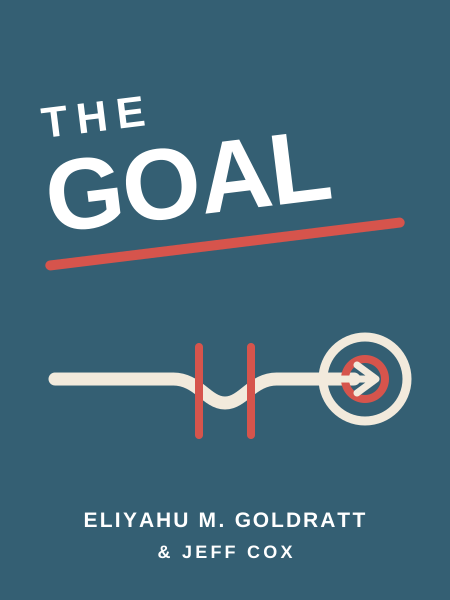
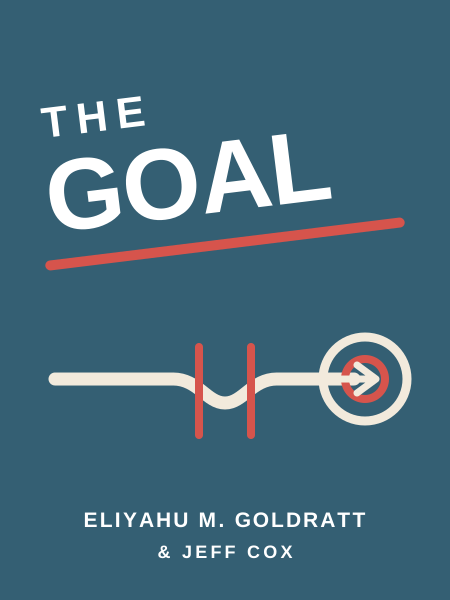
The Goal
Eliyahu M. Goldratt · 1984
Editorial rating
- Evidence
- 7/10
- Actionability
- 9/10
- Originality
- 9/10
The thesis
Every system has a constraint - a bottleneck that limits the entire operation's throughput. Optimizing anything other than the constraint is an illusion. Identify the constraint, exploit it fully, subordinate everything else to it, then elevate it. Repeat forever.
Who this is for
Operations managers drowning in efficiency metrics that don't improve results, consultants helping manufacturing or service businesses, and anyone who suspects that "working harder" isn't the answer.
My favorite quote
An hour lost at a bottleneck is an hour lost for the entire system. An hour saved at a non-bottleneck is a mirage.
Why it matters
This single insight demolishes the "keep everyone busy" mentality that destroys productivity in most organizations.
Do this
Identify the one constraint in your workflow right now. What would happen if you protected its capacity above all else?
Start here
Find the constraint - the one resource, step, or decision that limits your entire system's output. Everything upstream should flow only as fast as the constraint can process; everything downstream should be ready when the constraint outputs. Don't optimize non-constraints - you're just piling up inventory that creates problems elsewhere.
Critical summary
Goldratt, a physicist turned management consultant, presents the Theory of Constraints (TOC) through a gripping business novel. The protagonist Alex Rogo has 90 days to save his manufacturing plant from closure. Through Socratic dialogue with mentor Jonah, he discovers that traditional cost accounting creates perverse incentives and that only constraint-focused thinking produces real improvement.
The book's genius is its format: the technical concepts (throughput, inventory, operating expense, bottlenecks, statistical fluctuations, dependent events) are embedded in a compelling story that makes them memorable and emotionally resonant.
What it gets right
- The constraint concept is genuinely powerful and widely applicable beyond manufacturing
- Devastating critique of cost accounting's focus on "local efficiencies" that harm global throughput
- The Five Focusing Steps provide a clear, repeatable methodology
- Written as a novel, it's engaging in ways that business books rarely are
What it misses
- The manufacturing context may feel dated or inapplicable to knowledge workers
- Goldratt keeps some concepts opaque (his scheduling algorithm was never fully published)
- The book spawned a consulting industry that sometimes oversells TOC as a silver bullet
- Limited discussion of how to identify constraints in service or creative work
- Alex's marriage subplot is clunky and distracting
Despite being 40 years old, the core insights remain relevant. Any organization with workflow - which is every organization - can benefit from constraint thinking.
Key concepts
Throughput
The rate at which the system generates money through sales. This is the goal - not cost reduction, not utilization.
Constraint (Bottleneck)
The resource that limits total throughput. Every system has one, and it shifts as you improve.
Inventory
Money invested in things you intend to sell. A liability, not an asset - it ties up cash and creates complexity.
Operating Expense
Money spent turning inventory into throughput. The third measure, but not the primary focus.
Dependent Events & Statistical Fluctuations
Variation compounds when processes are sequential. This is why "balanced" capacity is a myth.
Drum-Buffer-Rope
The constraint sets the pace (drum), buffers protect it from disruption, and release of work is paced to the constraint (rope).
Core insights
-
The goal is to make money - not stay busy
High utilization of non-constraints is waste if it creates inventory that the constraint can't process.
-
Local efficiency is a trap
Optimizing individual steps often suboptimizes the whole. Focus on global throughput, not local metrics.
-
Balance flow, not capacity
You don't want every step at 100% utilization - you want smooth flow through the constraint.
-
Variation kills dependence
In sequential processes, the slowest step determines speed, and variation accumulates. Build buffers before constraints.
-
Cost accounting lies
Traditional metrics (cost per unit, efficiency) reward behaviors that harm throughput. Measure throughput directly.
Implementation steps
Today
- Identify the constraint in your team or process - where does work pile up waiting?
- Calculate: if the constraint ran at 100% capacity 24/7, how much more could the system produce?
This week
- Protect the constraint: eliminate any interruptions, meetings, or context-switching that reduce its output
- Subordinate non-constraints: if they're producing faster than the constraint can handle, slow them down
This month
- Implement a buffer before the constraint to ensure it's never starved of work
- Elevate the constraint: add capacity, hire, automate, or redesign to increase throughput
Ongoing
- After elevating, identify the new constraint (it will shift)
- Never let inertia become the constraint - question yesterday's constraint
Suggested 30-day practice plan
An editorial application plan created by Monolithic Vault - an interpretation of the book's ideas, not part of the original book.
- Day 1
Read the hiking troop chapter; understand why balanced capacity fails with variation
- Day 2
Map your workflow; identify where inventory (work, emails, requests) piles up
- Day 3
Confirm your constraint by asking: "If this step had unlimited capacity, would output increase?"
- Day 7
Protect the constraint - eliminate any non-essential demand on its time
- Day 14
Implement a buffer - ensure the constraint always has work ready
- Day 21
Measure throughput before and after constraint focus; document the delta
- Day 30
Identify where the constraint has shifted; repeat the cycle
Free PDF summary
Take this analysis with you: a designed two-page field-notes sheet with the thesis, my favorite quote, the key concepts and core insights, and the full 30-day checklist. Print it or keep it - free, no signup.
Go deeper
If this analysis earned your attention, the full book goes further than any summary can. The original is always the primary source.