The Dichotomy of Leadership
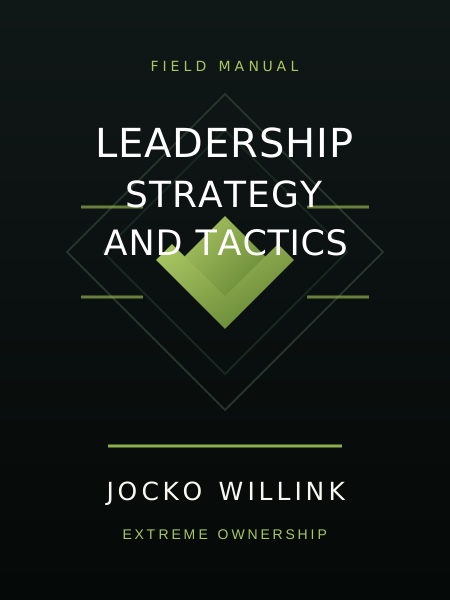
Jocko Willink and Leif Babin · 2018
Editorial rating
- Evidence
- 8/10
- Actionability
- 9/10
- Originality
- 8/10
The thesis
Extreme Ownership requires balance. Every leadership virtue becomes a vice when taken too far - care too much and you sacrifice the mission, own everything and your team stops leading themselves. Mastery is finding the center between opposing forces.
Who this is for
Leaders who read Extreme Ownership and pushed principles to counterproductive extremes, managers struggling to balance caring for people with driving results, and anyone navigating the tension between authority and empowerment.
My favorite quote
When a leader takes so much ownership that members of the team feel there is nothing left for which they can take ownership, team members will execute only at the boss's specific direction without any buy-in themselves.
Why it matters
This names the paradox: the thing that makes you effective (ownership) destroys effectiveness when overdone.
Do this
Tomorrow, identify one task you're micromanaging. Hand it to someone else completely - resist the urge to check in.
Start here
Leadership is finding the balance point on 12 dichotomies. You can't be purely aggressive or purely cautious - you need both, calibrated to context. The skill isn't picking a side; it's knowing when to dial each extreme up or down. No formula exists - you develop judgment through experience and self-awareness.
Critical summary
Willink and Babin's follow-up to Extreme Ownership addresses the question: "Can you take these principles too far?" Answer: yes. The dichotomy is that leadership virtues become liabilities at extremes. Care deeply for your team - but not so much you can't send them into danger. Own everything - but empower others to own their piece. Be humble - but not so humble you can't make hard calls.
The 12 Dichotomies
- Care for people vs. accomplish the mission
- Own it all vs. empower others (micromanagement vs. hands-off)
- Resolute vs. overbearing
- When to mentor vs. when to fire
- Train hard vs. train smart
- Aggressive vs. reckless
- Disciplined vs. rigid
- Hold accountable vs. micromanage
- Leader vs. follower
- Focused vs. detached
- Confident vs. humble
- Competitive vs. cooperative
What it gets right
- Extreme anything fails: Pure aggression is recklessness, pure caution is paralysis
- Context determines the right balance: What works in combat differs from boardroom, what works with veterans differs from rookies
- Leaders create culture through modeling: Your team watches where you sit on each spectrum and adjusts accordingly
- Humility enables adjustment: Knowing you might be out of balance is prerequisite to finding balance
- Micromanagement kills initiative: When leaders take all ownership, teams become order-takers who await direction
What it misses
- Somewhat redundant: If you read Extreme Ownership and understood nuance, this clarifies obvious caveats
- Combat examples don't always translate: Ramadi firefights are high-stakes but binary - business has more ambiguity
- Light on how to actually find balance: "It depends on context" is accurate but not prescriptive
- Assumes functional organizations: In truly toxic cultures, these dichotomies can't save you
Evidence quality: Moderate. Combat examples are real (Willink/Babin commanded SEAL teams in Ramadi), business consulting examples are client stories. This is wisdom-from-practice, not research. The dichotomy framework is useful mental model but not empirically validated. Think of it as sophisticated pattern recognition from elite performers, not science.
Critics note it's "common sense" packaged dramatically - true, but common sense is uncommon in practice. The value is naming the tensions explicitly so you can diagnose when you're out of balance.
Key concepts
The Ultimate Dichotomy
Care deeply for your people while sending them into situations that could kill them. Balance mission success with team welfare. Neither can be absolute.
Own It All, Empower Others
Take full responsibility for outcomes while giving subordinates ownership of execution. Today: identify one decision you'll delegate completely.
Disciplined, Not Rigid
SOPs give you freedom to deviate intelligently. Discipline creates baseline, flexibility adapts to reality. This week: create one process, then practice breaking it when context demands.
Aggressive, Not Reckless
Default to action, but assess risks first. "Violence of action" with planning, not impulse. Tomorrow: pick the aggressive move that has calculated upside.
Leader and Follower
Good leaders know when to step back and let others lead. Best idea wins, regardless of rank. Today: let someone else run the meeting.
Core insights
-
"There is no growth in the comfort zone"
But too much discomfort breaks people. The dichotomy: push hard enough to grow, not so hard you burn out the team.
-
Micromanagement kills initiative
When you own everything, your team owns nothing. They await orders instead of solving problems. Result: you become the bottleneck.
-
Anger is weakness, not strength
Speaking angrily is losing control. Aggression should target problems, not people. Temper tantrums signal you're out of balance.
-
Winning requires flexibility, not just will
Most people think "relentless" means rigid. Truth: real winners adapt, compromise, and humble themselves more than people realize.
-
You can't plan for every contingency
Trying to de-risk everything overburdens you. Accept uncertainty, prepare for likely scenarios, improvise the rest.
Implementation steps
Today
- List your current dichotomies: Where are you out of balance right now? (Too hands-on? Too passive?)
- Pick one area to recalibrate: If you're micromanaging, delegate completely. If you're too hands-off, get more involved.
This week
- Practice one dichotomy daily: Monday = care/mission balance, Tuesday = lead/follow, etc.
- Seek feedback: Ask team "Am I too X or not enough Y?" (too aggressive? too cautious?)
- Notice your defaults: Do you naturally lean too far one direction?
This month
- Audit all 12 dichotomies: Rate yourself 1-10 on each (1=too little, 10=too much, 5=balanced)
- Correct the extremes: Pick your 3 most imbalanced and deliberately overcorrect for a week
- Build self-awareness rituals: Daily reflection - where was I out of balance today?
Ongoing
- Default to asking "Am I too far one way?" before making leadership decisions
- Remember: leadership is dynamic, not static - balance shifts with context
- Model the balance: Your team learns by watching where you sit on each spectrum
Suggested 30-day practice plan
An editorial application plan created by Monolithic Vault - an interpretation of the book's ideas, not part of the original book.
- Day 1
Read Part I, identify which dichotomy you most struggle with
- Day 2
Delegate one task you've been micromanaging - resist checking in
- Day 3
Practice being resolute without being overbearing - make a hard call and explain why
- Day 7
Assess care/mission balance - are you prioritizing people over results or vice versa?
- Day 14
Hold someone accountable without micromanaging - set standard, check outcome, don't hover over process
- Day 21
Practice leader/follower - let someone else make the call even when you could
- Day 30
Review all 12 dichotomies - rate yourself on each, pick 3 to focus on next month
Free PDF summary
Take this analysis with you: a designed two-page field-notes sheet with the thesis, my favorite quote, the key concepts and core insights, and the full 30-day checklist. Print it or keep it - free, no signup.
Go deeper
If this analysis earned your attention, the full book goes further than any summary can. The original is always the primary source.