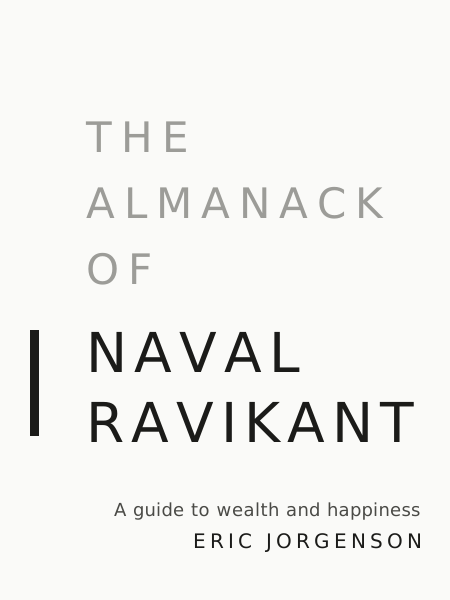
The Almanack of Naval Ravikant
Eric Jorgenson · 2020
Editorial rating
- Evidence
- 6/10
- Actionability
- 7/10
- Originality
- 8/10
The thesis
Wealth and happiness are skills you can learn, not traits you're born with or lottery tickets you win. Seek wealth through ownership and leverage, seek happiness through presence and acceptance - and understand that these two pursuits require different, sometimes contradictory, mindsets.
Who this is for
Ambitious professionals questioning the "work harder" narrative, entrepreneurs seeking a philosophical foundation for their pursuits, and anyone who's achieved financial success but still feels unfulfilled.
My favorite quote
Seek wealth, not money or status. Wealth is having assets that earn while you sleep. Money is how we transfer time and wealth. Status is your place in the social hierarchy.
Why it matters
Most people confuse these three things. Money without assets is a treadmill. Status is a zero-sum game. Only wealth - ownership of productive assets - creates lasting freedom.
Do this
Audit your income sources. How much comes from trading time? How much from assets you own? Set a goal to shift that ratio.
Start here
Specific knowledge is your unfair advantage: knowledge so unique to you - your interests, your experiences, your quirks - that it can't be trained or outsourced. If society can train you to do something, it can train someone cheaper. Find what feels like play to you but work to others, then stack it with leverage (code, media, capital, labor) to create asymmetric returns.
Critical summary
Eric Jorgenson compiled Naval Ravikant's wisdom from tweets, podcasts, and interviews into a cohesive guide to wealth and happiness. Naval - founder of AngelList, early investor in Twitter and Uber - has become an unlikely philosopher-king of Silicon Valley, offering insights that blend venture capital wisdom with Stoic and Buddhist philosophy.
The book is divided into two parts: Building Wealth (specific knowledge, leverage, judgment, long-term games) and Building Happiness (desire as suffering, choosing happiness, meditation, acceptance). Naval's core insight is that getting rich is a skill - learnable and replicable - not a matter of luck or inheritance.
What it gets right
- Clear articulation of leverage types: labor, capital, code, media (the last two require no permission)
- "Specific knowledge" concept elegantly explains why some skills command premium returns
- Happiness section provides genuine depth, not just wealth-signaling pseudo-philosophy
- Free, which removes the suspicion that it's a cash grab
What it misses
- Survivorship bias: Naval's advice worked for Naval, but n=1 is not evidence
- The "book" is more curated aphorisms than coherent argument - some find it fragmented
- Limited discussion of luck, privilege, and systemic factors in wealth creation
- Can read as justification for tech-bro libertarianism rather than universal wisdom
Evidence is primarily Naval's experience and reading. The ideas synthesize Stoicism, Buddhism, Taleb, Munger, and startup culture into something new - but they're not empirically validated beyond "it worked for me."
Key concepts
Specific Knowledge
Skills that can't be taught or outsourced because they emerge from your unique combination of interests, experiences, and personality.
Leverage
Labor (manage people), capital (invest money), code (write software), media (create content). The last two scale without permission.
Accountability
Take risks under your own name. This builds credibility and attracts opportunity.
Long-Term Games
Play long-term games with long-term people. Compound interest works on relationships too.
Happiness as Default State
Happiness isn't something to pursue - it's what remains when you remove the sense that something is missing.
Desire as Suffering
Every desire is a contract you make with yourself to be unhappy until you get what you want.
Core insights
-
Arm yourself with specific knowledge, leverage, and accountability
This is Naval's formula for wealth. Miss one and you're trading time for money.
-
Code and media are permissionless leverage
You don't need anyone's permission to write software or create content. This is the new path to wealth.
-
Happiness is a choice, not a circumstance
You can choose to be happy right now by accepting the present moment and releasing desires.
-
Reading is the ultimate meta-skill
Books are the best ROI on time investment. Read what you love until you love to read.
-
Play long-term games
Returns compound when you play the same game repeatedly with the same people. Short-term thinking destroys wealth and relationships.
Implementation steps
Today
- List your specific knowledge: What do you know that few others do? What feels like play to you but work to others?
- Calculate how much of your income depends on your time vs. assets you own
This week
- Identify one form of permissionless leverage (code or media) you could start building
- Notice every desire that arises and label it: "This is a contract to be unhappy until X"
This month
- Begin creating content or building a product that leverages your specific knowledge
- Establish a daily meditation practice (even 10 minutes)
Ongoing
- Invest in long-term relationships with high-integrity people
- Read deeply in areas of genuine interest, not just what's "useful"
Suggested 30-day practice plan
An editorial application plan created by Monolithic Vault - an interpretation of the book's ideas, not part of the original book.
- Day 1
Write down your "specific knowledge" inventory - skills, interests, and experiences
- Day 2
Audit your income: time-based vs. asset-based. Set a 5-year ratio goal.
- Day 3
Choose one permissionless leverage channel (newsletter, podcast, YouTube, software) to explore
- Day 7
Launch version one of your leverage project - imperfect is fine
- Day 14
Begin a daily meditation practice (start with 10 minutes using an app)
- Day 21
Review your "desire contracts" - which are worth honoring? Which are making you unhappy?
- Day 30
Identify 3 people to play long-term games with; invest in those relationships
Free PDF summary
Take this analysis with you: a designed two-page field-notes sheet with the thesis, my favorite quote, the key concepts and core insights, and the full 30-day checklist. Print it or keep it - free, no signup.
Go deeper
If this analysis earned your attention, the full book goes further than any summary can. The original is always the primary source.