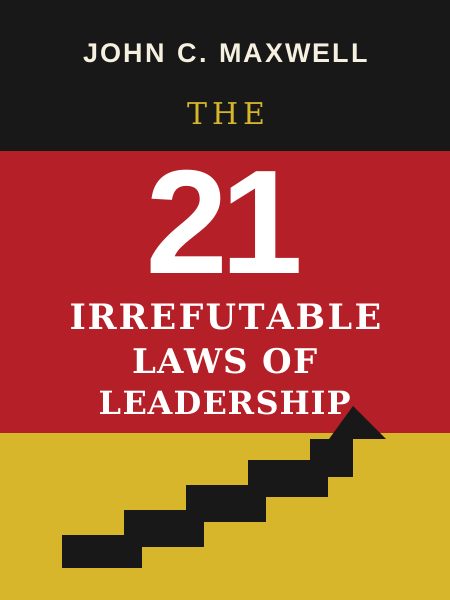
The 21 Irrefutable Laws of Leadership
John C. Maxwell · 1998
Editorial rating
- Evidence
- 5/10
- Actionability
- 6/10
- Originality
- 5/10
The thesis
Leadership is influence - nothing more, nothing less. Your effectiveness as a leader is capped by your leadership ability (the "lid"), and this ability can be systematically developed through 21 foundational laws that govern how people follow, trust, and multiply through leaders.
Who this is for
First-time managers seeking a leadership framework, mid-career professionals who've plateaued, and anyone who leads without formal authority. Particularly suited for those who prefer principles over tactical playbooks.
My favorite quote
He who thinks he leads, but has no followers, is only taking a walk.
Why it matters
This cuts through the ego trap of leadership. Titles, corner offices, and authority mean nothing without actual influence. The proof is in who follows.
Do this
List five people you believe you lead. For each, honestly assess: do they follow because of your position or because of your influence? If mostly position, you have work to do.
Start here
The Law of the Lid: Your leadership ability determines your level of effectiveness. If your leadership is a 4 out of 10, your effectiveness is capped at 4 - no matter how hard you work. Raising your leadership lid has a multiplier effect on everything you do. Before optimizing tactics, ask: "What's my current leadership lid, and how do I raise it?"
Critical summary
Maxwell distills leadership into 21 "laws" drawn from historical examples, business cases, and personal experience. Each law represents a principle that governs leadership effectiveness: influence, process, navigation, trust, empowerment, and more.
The book's structure - one chapter per law with stories and application questions - makes it accessible and quotable. Maxwell writes for Christian and business audiences, though religious elements are subtle.
What it gets right
- "Leadership = Influence" is a useful reframe away from positional authority
- The "Lid" concept explains why talented people plateau
- Diverse examples (Mother Teresa, McDonald's founders, sports coaches) illustrate principles broadly
- Each law is independently actionable
What it misses
- Laws are "irrefutable" but actually quite debatable - some are platitudes dressed up
- Evidence is primarily anecdotal, not research-based
- Best-seller status was artificially inflated by ResultSource bulk-buying scandal
- Some critics note it's "cheesy but useful" - tone may not suit all readers
- 21 laws is a lot; no prioritization guidance on where to start
- Oversimplifies complex organizational dynamics
Evidence is almost entirely stories and examples, not rigorous research. The principles resonate practically but lack empirical validation.
Key concepts
The Law of the Lid
Leadership ability caps effectiveness. Rate yourself 1-10 and work to raise your lid.
The Law of Influence
True leadership is influence earned, not position assigned. Audit your actual influence.
The Law of Process
Leadership develops daily, not in a day. Commit to ongoing development, not one-time training.
The Law of Solid Ground
Trust is the foundation. Without it, leadership crumbles quickly.
The Law of the Inner Circle
Those closest to you determine your potential. Evaluate who's in yours.
The Law of Empowerment
Only secure leaders give power to others. Develop others even if they might outgrow you.
Core insights
-
Titles buy time, not loyalty
A new position gives you a window to build influence - nothing more. Use it or lose it.
-
People buy into the leader before the vision
If they don't trust you, your vision is irrelevant. Lead yourself first.
-
Leaders see more and see before
Navigation means charting the course when others can't see the destination.
-
Connecting precedes directing
Touch hearts before asking for hands. People follow leaders who care about them.
-
Everything rises and falls on leadership
If your organization is stuck, look at leadership first - always.
Implementation steps
Today
- Rate your leadership ability 1-10 (be honest)
- List 3-5 people in your "inner circle" and evaluate what each contributes
This week
- Ask 3 trusted colleagues to rate your leadership (compare to self-rating)
- Identify one law where you're weakest - focus development there
- Start a leadership journal: daily, note one leadership observation or lesson
This month
- Read one leadership book or complete one development activity
- Schedule regular 1:1s with key people you're developing
- Practice one specific behavior from your weakest law
Ongoing
- Annual leadership self-assessment against all 21 laws
- Continuous development: conferences, books, mentors, practice
- Intentionally develop other leaders (Law of Explosive Growth)
Suggested 30-day practice plan
An editorial application plan created by Monolithic Vault - an interpretation of the book's ideas, not part of the original book.
- Day 1
Self-assess all 21 laws, identify top 3 strengths and top 3 weaknesses
- Day 2
Get external feedback - ask 3 people to rate your leadership
- Day 3
Choose one law to focus on for the next 30 days
- Day 7
Create specific behavior goals for your focus law
- Day 14
Check progress - are you practicing the behavior daily?
- Day 21
Add one more law to your development focus
- Day 30
Review: What's changed? What's your new lid rating?
Free PDF summary
Take this analysis with you: a designed two-page field-notes sheet with the thesis, my favorite quote, the key concepts and core insights, and the full 30-day checklist. Print it or keep it - free, no signup.
Go deeper
If this analysis earned your attention, the full book goes further than any summary can. The original is always the primary source.