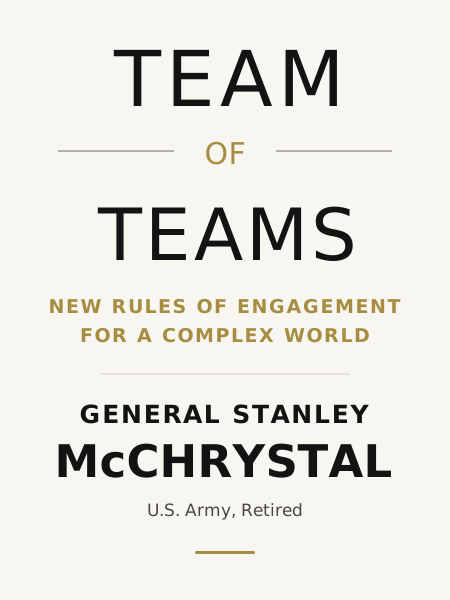
Team of Teams
Stanley McChrystal · 2015
Editorial rating
- Evidence
- 7/10
- Actionability
- 7/10
- Originality
- 8/10
The thesis
In complex environments, efficiency-optimized hierarchies fail. Victory goes to organizations that prioritize adaptability over efficiency, pushing decision-making to the edges while maintaining shared consciousness through radical transparency. Be a gardener, not a chess master.
Who this is for
Leaders of large organizations facing unpredictable competition, executives frustrated that their well-resourced teams keep losing to nimbler rivals, and anyone managing in VUCA (volatile, uncertain, complex, ambiguous) environments.
My favorite quote
The temptation to lead as a chess master, controlling each move of the organization, must give way to an approach as a gardener, enabling rather than directing.
Why it matters
This reframes leadership from control to cultivation - a fundamental shift for command-and-control veterans.
Do this
Identify one decision you're currently holding that someone closer to the problem should make. Delegate it today.
Start here
Create shared consciousness before you decentralize execution. Most organizations fail at decentralization because they push decisions down without first ensuring everyone understands the strategic context. Daily briefings, radical information sharing, and liaison personnel build the shared understanding that makes local decisions globally coherent.
Critical summary
McChrystal led Joint Special Operations Command in Iraq and discovered that the most advanced military force in history was being outmaneuvered by a decentralized terrorist network. The book explains how he transformed a rigid hierarchy into a network of teams that could adapt at the speed of the environment.
The central insight is distinguishing between complicated and complex systems. Complicated systems (like a car engine) have many parts but are predictable. Complex systems (like weather or insurgencies) are inherently unpredictable - small changes cascade in unexpected ways. Taylor's scientific management works for complicated problems; it fails for complex ones.
What it gets right
- The complicated vs. complex distinction is genuinely clarifying
- Practical frameworks for information sharing at scale (the O&I brief)
- Honest about the tradeoffs between efficiency and adaptability
- Liaison and embedding programs create real cross-team bonds
What it misses
- Military contexts don't always translate - most readers aren't fighting insurgencies
- Heavy on SEAL culture; undersells contributions from non-SOF units
- Strategy still matters; the book can read as "organization solves everything"
- Light on how to maintain this culture during peacetime or low-urgency periods
- The "eyes on, hands off" approach requires extremely high trust that takes years to build
Evidence is primarily McChrystal's personal experience, supplemented by historical case studies. The framework is compelling but not empirically validated.
Key concepts
Team of Teams
Scale the trust and purpose of small teams across large organizations by creating connections between teams, not just within them.
Shared Consciousness
Radical transparency where everyone understands the strategic context, enabling local decisions to align with global objectives.
Empowered Execution
Push authority to the edges once shared consciousness exists. The person closest to the problem makes the call.
Liaison Officers
Embed people from one team into another to create human bridges. They carry context and relationships back and forth.
O&I Brief
Operations and Intelligence briefing - daily all-hands where information flows freely and leaders model transparency.
Eyes On, Hands Off
Leaders see everything (transparency) but resist the urge to intervene (trust). Maintain awareness without creating dependency.
Core insights
-
Efficiency kills adaptability
Optimizing each part locally often destroys system-wide effectiveness. In complex environments, resilience beats efficiency.
-
Need-to-know destroys speed
Information hoarding assumes someone knows who needs what. In complexity, no one knows - so share everything.
-
Trust is the transfer protocol
Information flows through relationships. Build relationships across silos, and information follows.
-
The 70% solution today beats the 90% solution tomorrow
Speed matters more than perfection in fast-moving environments.
-
Resilience over prediction
You cannot predict complex systems. Build organizations that respond quickly to whatever emerges.
Implementation steps
Today
- Identify one piece of information you're hoarding that others could use
- Map the liaisons between your team and other teams - where are the gaps?
This week
- Observe your decision patterns: Which decisions do you make that someone closer could make better?
- Start a brief daily standup focused on information sharing, not status updates
This month
- Establish one liaison relationship: embed someone from your team with another team for a week
- Create a "strategic context" document that explains the why behind your team's work
Ongoing
- Default to sharing information unless there's a specific reason not to
- Ask weekly: "What decision did I make this week that someone else should have made?"
Suggested 30-day practice plan
An editorial application plan created by Monolithic Vault - an interpretation of the book's ideas, not part of the original book.
- Day 1
Audit your information sharing - what do you know that your team doesn't?
- Day 2
Start a daily 15-minute brief focused on cross-team intelligence, not status
- Day 3
Identify three decisions you're holding that should be delegated
- Day 7
Establish your first liaison - send someone to shadow another team
- Day 14
Create a shared context document explaining strategic objectives and constraints
- Day 21
Review decision velocity - are decisions happening faster at the edges?
- Day 30
Assess trust levels across team boundaries; identify and address weak links
Free PDF summary
Take this analysis with you: a designed two-page field-notes sheet with the thesis, my favorite quote, the key concepts and core insights, and the full 30-day checklist. Print it or keep it - free, no signup.
Go deeper
If this analysis earned your attention, the full book goes further than any summary can. The original is always the primary source.