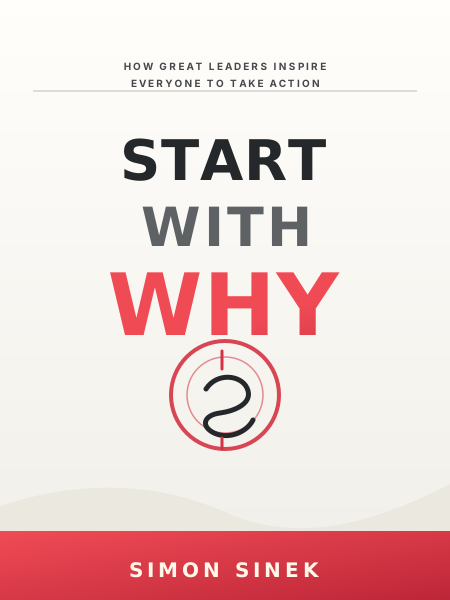
Start with Why
Simon Sinek · 2009
Editorial rating
- Evidence
- 4/10
- Actionability
- 6/10
- Originality
- 7/10
The thesis
People don't buy what you do - they buy why you do it. Great leaders and organizations inspire action by starting with purpose (the "Why"), then moving to process (the "How"), and finally to product (the "What"). This inside-out approach creates loyalty and differentiation.
Who this is for
Leaders wanting to inspire rather than manipulate, marketers seeking authentic differentiation, and founders struggling to articulate what makes their company special beyond features and price.
My favorite quote
People don't buy what you do; they buy why you do it. And what you do simply proves what you believe.
Why it matters
This inverts conventional marketing wisdom. Features and benefits matter less than shared values and purpose.
Do this
Write down why your organization exists beyond making money. If you can't, that's the problem.
Start here
The Golden Circle: Most organizations communicate from the outside in - starting with What they do, sometimes mentioning How, rarely explaining Why. Inspiring organizations reverse this: they start with Why (their purpose), explain How (their unique approach), and finally describe What (their products). This sequence connects with how humans actually make decisions.
Critical summary
Sinek, originally from the advertising world, introduces the "Golden Circle" framework that became one of the most-watched TED talks of all time. The book expands on how purpose-driven communication inspires loyalty and action.
What it gets right
- Simple, memorable framework (Why → How → What)
- Connects purpose to emotional decision-making
- Apple example illustrates the power of belief-based marketing
- Differentiates inspiration from manipulation
- Accessible introduction to purpose-driven leadership
What it misses
- Relies heavily on anecdotal examples (Apple, Martin Luther King Jr.)
- Neuroscience claims ("limbic brain") are oversimplified and disputed
- Less guidance on HOW to find your Why (addressed in later book, Find Your Why)
- Cherry-picks success stories - ignores purpose-driven companies that failed
- TiVo "failure" example has been criticized as misattributed
Evidence is primarily anecdotal with disputed neuroscience claims. Compelling concept but lacks rigorous research backing.
Key concepts
The Golden Circle
Why (purpose) → How (process) → What (product). Communicate from the inside out.
The Why
Your purpose, cause, or belief. Not profit - that's a result. "Why do you get out of bed in the morning?"
Start with Why
Lead all communication with purpose. Then explain how you fulfill it, then what you offer.
Manipulation vs. Inspiration
Price, promotions, and fear are manipulations. They work short-term but don't build loyalty. Inspiration builds tribes.
The Law of Diffusion
Early adopters buy "Why." To cross the chasm to the majority, you need 15-18% penetration with believers first.
Core insights
-
Loyalty comes from belief, not satisfaction
Customers who share your values are forgiving and evangelical. Satisfied customers just got a good deal.
-
Why attracts the right people
When you're clear about purpose, you attract employees and customers who believe what you believe.
-
The What is proof of the Why
Products and services are evidence of your beliefs, not the source of differentiation.
-
Manipulation has a ceiling
Price wars, promotions, and fear tactics work but erode margins and create no loyalty.
-
The How matters too
Authentic Hows (values, principles) must connect the Why to the What.
-
Split between leader and organization is dangerous
If the Why lives only in the founder, the company risks losing it when they leave.
Implementation steps
Today
- Write down your organization's Why in one sentence (not what you do or how you do it)
- Ask three team members why the company exists - compare answers
This week
- Audit your current marketing: Does it start with Why, or with What?
- Rewrite one piece of communication to lead with purpose
This month
- Identify your "How" - the values and principles that guide how you operate
- Test: Does your team's behavior match the stated Why?
Ongoing
- In every presentation, start with Why before describing What
- Hire for belief alignment, not just skill
Suggested 30-day practice plan
An editorial application plan created by Monolithic Vault - an interpretation of the book's ideas, not part of the original book.
- Day 1
Write your personal Why in one sentence
- Day 2
Write your organization's Why (what it should be)
- Day 3
Compare current messaging - does it reflect the Why?
- Day 7
Rewrite one marketing piece to start with Why
- Day 14
Share the Why with your team - does it resonate?
- Day 21
Identify gaps between stated Why and actual behavior
- Day 30
Refine the Why based on feedback. Make it clearer, more compelling.
Free PDF summary
Take this analysis with you: a designed two-page field-notes sheet with the thesis, my favorite quote, the key concepts and core insights, and the full 30-day checklist. Print it or keep it - free, no signup.
Go deeper
If this analysis earned your attention, the full book goes further than any summary can. The original is always the primary source.