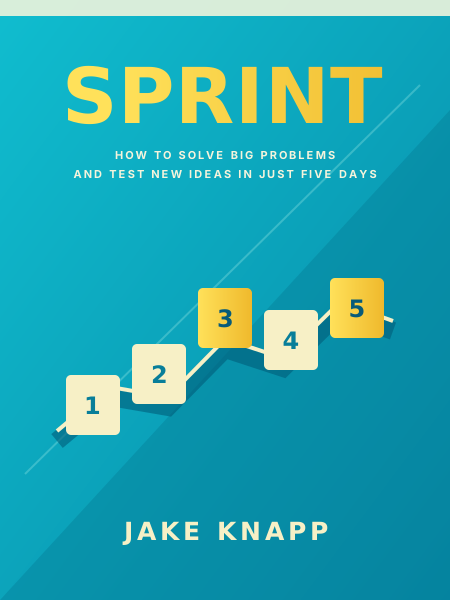
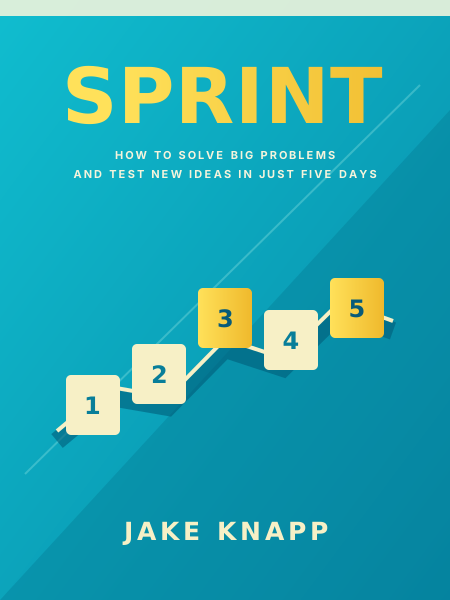
Sprint
Jake Knapp · 2016
Editorial rating
- Evidence
- 8/10
- Actionability
- 9/10
- Originality
- 8/10
The thesis
You can answer critical business questions in five days through structured prototyping and testing - not months of development. The sprint compresses an entire build-measure-learn cycle into one week by forcing decisions, eliminating debate, and testing with real customers.
Who this is for
Product teams facing big challenges with unclear solutions, founders validating ideas before building, and anyone who needs to break organizational gridlock around important decisions. Requires a team willing to commit five full days.
My favorite quote
The sprint gives teams a shortcut to learning without building and launching.
Why it matters
Most teams spend months building features users don't want. The sprint inverts this: learn what works before committing engineering resources.
Do this
Identify your team's biggest current "should we build X?" question. Schedule a five-day block to sprint on it instead of debating further.
Start here
Friday Testing: The entire sprint builds toward putting a realistic prototype in front of five real customers on Day 5. Five interviews reveal 85% of usability issues. You don't need statistical significance - you need to watch people struggle and succeed. Everything earlier in the week (mapping, sketching, deciding, prototyping) exists to make Friday's learning possible.
Critical summary
Knapp, a design partner at Google Ventures, codifies the process GV uses with portfolio companies. The five-day structure is rigidly prescribed: Monday (map the problem), Tuesday (sketch solutions), Wednesday (decide), Thursday (prototype), Friday (test with customers).
The book's greatest strength is its extreme specificity. Where most design thinking books speak in principles, Sprint provides minute-by-minute schedules, supply lists, and exact facilitation scripts. This makes it immediately implementable.
What it gets right
- Timeboxing eliminates analysis paralysis and endless debate
- "Decider" role prevents design-by-committee
- Realistic prototypes (not wireframes) get real reactions
- Five customer interviews as validation gold standard
- Battle-tested across 100+ GV companies
What it misses
- Highly prescriptive - modifications often break the process
- Requires full five-day commitment from entire team (expensive, hard to schedule)
- Assumes you can recruit five target customers within a week
- No bibliography or research citations (we're just trusting GV's experience)
- Less useful for problems that require technical feasibility testing
- Prototype fidelity guidance could be stronger
Evidence is primarily GV portfolio case studies. The process clearly works in that context, but applicability to different organizational cultures (slower-moving enterprises, non-tech companies) is less proven.
Key concepts
The Sprint
Five-day process - Map, Sketch, Decide, Prototype, Test. Block the calendar for all five days.
The Decider
One person with authority makes final calls to prevent design-by-committee. Identify yours before starting.
Lightning Demos
3-minute presentations of existing solutions/inspiration. Do research before sketching.
Crazy 8s
Fold paper into 8 sections, sketch 8 variations in 8 minutes. Quantity forces creativity.
Storyboard
Scene-by-scene blueprint for Thursday's prototype. Gets team aligned on what exactly to build.
Five-Act Interview
Structured customer interview format - friendly intro, context questions, prototype task, detailed feedback, debrief.
Core insights
-
Start at the end
Begin Monday by defining what success looks like in 6 months, then work backward. The sprint target must be specific.
-
Together alone
Work in same room but sketch solutions individually. Groups don't brainstorm well; individuals do.
-
Decide, don't debate
Use structured voting (dot voting, "decider picks winner") instead of consensus discussions that drag endlessly.
-
Realistic fake
Thursday's prototype should feel real enough that customers react genuinely. "Goldilocks quality" - enough to learn, not more.
-
Five is enough
Five customer interviews reveal most usability patterns. Don't wait for statistically significant samples - watch five people and you'll know.
Implementation steps
Today
- Identify a "big challenge" your team has been debating
- List who must be in the room (decider, experts, maker, facilitator)
This week
- Block five consecutive days on all participants' calendars
- Recruit five target customers for Friday interviews
- Gather supplies (whiteboards, markers, sticky notes, printer)
This month
- Run your first sprint following the exact schedule
- Document outcomes and learnings
- Decide: build, iterate, or pivot based on Friday's results
Ongoing
- Use sprints quarterly for major product decisions
- Train additional facilitators to run sprints
- Build customer recruitment pipeline for future Friday testing
Suggested 30-day practice plan
An editorial application plan created by Monolithic Vault - an interpretation of the book's ideas, not part of the original book.
- Day 1
Identify sprint challenge and required participants
- Day 2
Get decider commitment and calendar holds from all participants
- Day 3
Begin customer recruitment for Friday interviews (aim for 7 scheduled, expect 5 to show)
- Day 7
Confirm all logistics - room, supplies, customer schedule
- Day 14
Debrief with team - what did you learn? What's the decision?
- Day 21
Begin implementation based on sprint learnings (or plan next sprint)
- Day 30
Review: How much time/money did the sprint save vs. building first?
Free PDF summary
Take this analysis with you: a designed two-page field-notes sheet with the thesis, my favorite quote, the key concepts and core insights, and the full 30-day checklist. Print it or keep it - free, no signup.
Go deeper
If this analysis earned your attention, the full book goes further than any summary can. The original is always the primary source.