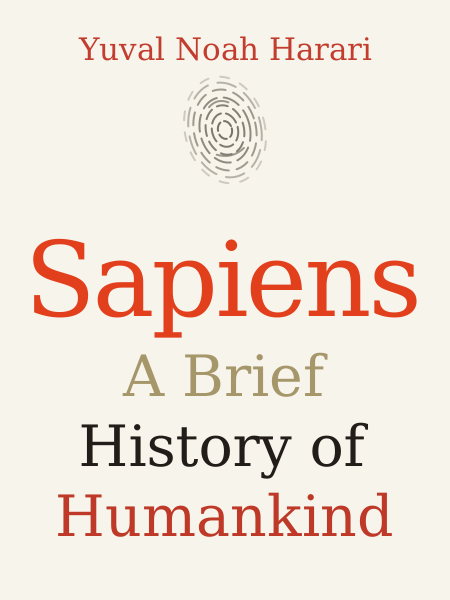
Sapiens
Yuval Noah Harari · 2011
Editorial rating
- Evidence
- 4/10
- Actionability
- 3/10
- Originality
- 7/10
The thesis
Homo sapiens conquered the world not through physical superiority but through our unique ability to believe in shared fictions - money, nations, religions, human rights. These "imagined orders" enable mass cooperation among strangers, but they also mean that everything we consider meaningful is, ultimately, a story we tell ourselves.
Who this is for
Big-picture thinkers who want a sweeping narrative of human history. Useful for consultants and strategists seeking frameworks for understanding human cooperation, institutional design, and cultural change - but approach with heavy skepticism.
My favorite quote
You could never convince a monkey to give you a banana by promising him limitless bananas after death in monkey heaven.
Why it matters
It captures Harari's central insight: humans alone can cooperate around abstract concepts. This is both our superpower and, arguably, our delusion.
Do this
Identify one "shared fiction" in your organization (mission statement, brand values, company culture). How does believing in it enable coordination that wouldn't otherwise happen?
Start here
Everything that enables humans to cooperate at scale - money, corporations, nations, religions, human rights - exists only because we collectively believe in it. These are "imagined orders," powerful not because they're true but because they're shared. Understanding this gives you X-ray vision into why institutions work, why they fail, and how narratives shape behavior. But be careful: Harari's relativism can become nihilism if you're not careful.
Critical summary
Harari, an Israeli historian, attempts to explain all of human history in 400 pages, organized around four revolutions: Cognitive (70,000 years ago), Agricultural (10,000 years ago), Unification (2,000 years ago), and Scientific (500 years ago). The book became a global phenomenon, praised by Obama, Gates, and Zuckerberg.
What it gets right
- The "imagined orders" framework is genuinely useful for understanding institutions and cooperation
- The writing is exceptionally clear and engaging - complex ideas made accessible
- The Agricultural Revolution critique (we didn't domesticate wheat; wheat domesticated us) is thought-provoking
- The scope is ambitious and the narrative sweep is impressive
What it misses or overstates
- Factual errors are numerous and substantial, according to experts in relevant fields
- The book escaped serious fact-checking by being so broad no single expert could critique all of it
- Anthropologist C.R. Hallpike found no "serious contribution to knowledge"
- The claim that foragers were happier than modern humans is idealized and contradicted by evidence
- Harari's ethical relativism (human rights are "fictions") undermines his own normative claims
- The book is often described as "sensationalist" and "exaggerated" by academic reviewers
- He presents speculative ideas as established fact without adequate qualification
Evidence quality: Poor by scholarly standards. Harari tells a compelling story but sacrifices accuracy for narrative. Philosopher Galen Strawson's devastating review noted "carelessness, exaggeration and sensationalism." The book thrived because no one is expert enough to critique everything, and the storytelling is seductive. Treat it as thought-provoking philosophy, not reliable history.
Key concepts
Imagined Orders
Shared beliefs (money, nations, religions) that exist only in collective human imagination but enable mass cooperation. Powerful because shared, not because true.
Cognitive Revolution
~70,000 years ago, humans developed language complex enough to discuss abstract concepts. This enabled cooperation among strangers.
Agricultural Revolution
Harari calls it "history's biggest fraud" - we worked harder for worse nutrition, but population grew. Wheat domesticated us.
Unification of Humankind
Money, empires, and religions gradually connected isolated human groups into a single global network.
Scientific Revolution
The admission of ignorance. For the first time, humans said "we don't know" and built systems to find out.
The Luxury Trap
Each "improvement" (agriculture, smartphones) creates new dependencies and baselines, leaving us no happier than before.
Core insights
-
Fiction enables cooperation at scale
Chimps can cooperate in groups of ~150 (Dunbar's number). Humans cooperate in millions because we believe the same stories. Corporations, nations, and religions are all fictions that enable coordination.
-
The Agricultural Revolution was a trap
Individual quality of life declined (harder work, worse diet, more disease), but population exploded. We traded quality for quantity and couldn't go back.
-
Money is the most successful story ever told
It's trust in a symbol, nothing more. But because everyone believes it, it enables trade between strangers with incompatible beliefs.
-
History has direction but no justice
Things get more connected and complex over time, but there's no guarantee they get better. Progress is a story, not a law.
-
We're at a turning point
Humans may soon engineer themselves into something unrecognizable. The next century will see more change than the previous 70,000 years.
Implementation steps
Today
- Identify three "imagined orders" you participate in (company, currency, nation). Notice how your behavior would change if you stopped believing in them.
- Question one assumption you've never questioned: Is it a fact or a shared fiction that serves a purpose?
This week
- In a meeting, observe how shared narratives (mission, values, market position) coordinate behavior without explicit instruction
- Read one critical review of Sapiens to understand its limitations
This month
- Apply the "imagined order" lens to a business problem: What shared belief would need to exist to solve it? Can you create that belief?
- Examine a conflict in your organization - is it about facts or about competing fictions?
Ongoing
- Use Harari's framework as a thinking tool, not a source of facts
- Recognize that stories are tools - they don't have to be "true" to be useful, but they should be chosen consciously
- Balance Harari's relativism with commitment to values - "fiction" doesn't mean "unimportant"
Suggested 30-day practice plan
An editorial application plan created by Monolithic Vault - an interpretation of the book's ideas, not part of the original book.
- Day 1
List 5 things you believe that only exist because humans collectively agree they exist (money, property rights, your job title, etc.)
- Day 3
Research one criticism of Sapiens. How does it change your view of the book's claims?
- Day 7
Apply the "luxury trap" concept: What modern convenience has become a necessity you can't live without?
- Day 14
Examine your organization's founding myth. How does it shape current behavior? Is it useful? Is it accurate?
- Day 21
Debate with someone: Are human rights "real" or a useful fiction? What are the implications of each position?
- Day 30
Write your own one-page "brief history" of your industry/field. What cognitive revolutions has it undergone?
Free PDF summary
Take this analysis with you: a designed two-page field-notes sheet with the thesis, my favorite quote, the key concepts and core insights, and the full 30-day checklist. Print it or keep it - free, no signup.
Go deeper
If this analysis earned your attention, the full book goes further than any summary can. The original is always the primary source.