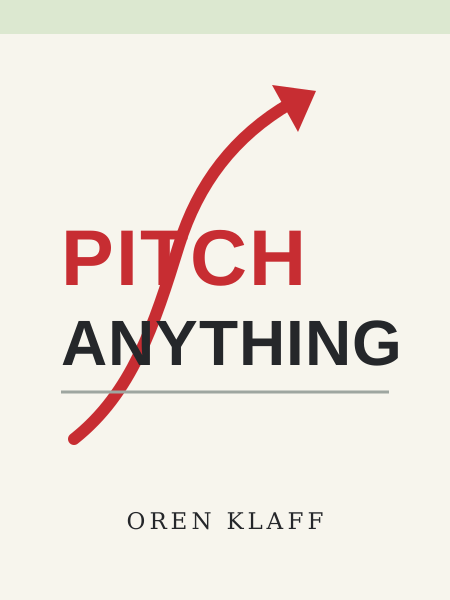
Pitch Anything
Oren Klaff · 2011
Editorial rating
- Evidence
- 5/10
- Actionability
- 8/10
- Originality
- 7/10
The thesis
Pitches fail because they target the wrong brain. We pitch with logic and analysis, but decisions are made by the primitive "croc brain" that craves novelty, simplicity, and emotional impact. Control the frame, speak to the croc brain, and you control the outcome.
Who this is for
Founders raising capital, salespeople pitching major deals, and anyone who needs to persuade skeptical audiences in high-stakes situations where attention is scarce and first impressions are everything.
My favorite quote
When you are reacting to the other person, that person owns the frame. When the other person is reacting to what you do and say, you own the frame.
Why it matters
This clarifies the invisible power dynamics in every pitch. Whoever is reacting is losing.
Do this
In your next pitch, notice who's adjusting to whom. If you're adapting to their schedule, their objections, their pace - you've lost frame before you started.
Start here
You are the prize, not the commodity. When you act like you need their money, approval, or time, you signal low status and trigger their croc brain to dismiss you. Flip the frame: your opportunity is scarce, their money is abundant. Make them qualify themselves to you.
Critical summary
Klaff, a capital markets director who has raised over $400 million, presents pitching as frame control - a battle for psychological dominance where the stronger perspective absorbs the weaker. His STRONG framework (Set the frame, Tell the story, Reveal the intrigue, Offer the prize, Nail the hookpoint, Get a decision) provides structure for high-stakes presentations.
The book's central insight is neurological: pitches are first processed by the primitive "crocodile brain," which filters for threats, novelty, and emotional relevance. Complex analysis never reaches the decision-making neocortex unless it first passes the croc brain's filter.
What it gets right
- Frame control concept is genuinely useful for understanding power dynamics in pitches
- "Prizing" (making yourself the sought-after party) is counterintuitive and effective
- The warning against neediness resonates - desperation is fatal in negotiations
What it misses
- Klaff's self-aggrandizing style is off-putting; the book reads like a victory lap
- Organization is chaotic - terminology ("four-frame hot cognition stacking") is scattered without clear reference
- Some techniques border on manipulation; the line between influence and coercion is blurry
- Advice assumes you have negotiating leverage; doesn't address power asymmetries
Evidence is primarily Klaff's personal experience. Neuroscience claims are simplified to the point of inaccuracy.
Key concepts
Croc Brain
The primitive brain that filters incoming information. If your pitch doesn't pass the croc brain, it never reaches the neocortex.
Frame Control
Every interaction is a collision of frames. The stronger frame absorbs the weaker. Own the frame or be owned.
Prizing
Position yourself as the prize, not the pursuer. Scarcity creates desire; neediness destroys it.
STRONG Method
Set frame, Tell story, Reveal intrigue, Offer prize, Nail hookpoint, Get decision.
Power Frame-Busting
When someone asserts dominance (making you wait, dismissing ideas), reframe with defiance plus humor.
The Analyst Trap
When they pull you into details and spreadsheets, they've killed momentum. Redirect to narrative.
Core insights
-
Neediness is the ultimate killer
The moment you signal you need them more than they need you, you've lost. Project options and abundance.
-
Defiance plus humor breaks frames
When someone tries to dominate you, pushback delivered playfully signals you're a peer, not a subordinate.
-
Novelty captures the croc brain
The primitive brain ignores the familiar. Lead with what's new, surprising, or threatening to their status quo.
-
Keep it simple, stupid (for real)
Only 10% of your message passes the croc brain filter. Make that 10% count. Complexity kills pitches.
-
Time pressure is leverage
"I have another meeting in 15 minutes" changes the dynamic. Scarcity of your attention increases its value.
-
Never split the power
If the decision-maker isn't in the room, delay. Subordinates can't convey your pitch with your power.
Implementation steps
Today
- Identify one upcoming pitch. Write down: Who holds the frame right now?
- Remove any language that signals neediness ("I really appreciate your time," "I hope you'll consider")
This week
- Practice the "prizing" mindset: You're evaluating whether they're right for you
- Prepare one novelty hook - what makes your pitch surprising?
This month
- Run one pitch where you set a time constraint ("I have 20 minutes")
- Use defiance-plus-humor once when someone tries to assert power over you
Ongoing
- Before every pitch, ask: Am I pursuing or being pursued? Adjust accordingly.
- Never pitch to subordinates - insist on decision-makers
Suggested 30-day practice plan
An editorial application plan created by Monolithic Vault - an interpretation of the book's ideas, not part of the original book.
- Day 1
Read about frame control; identify a recent pitch where you lost frame
- Day 2
Rewrite your opening to lead with novelty, not background
- Day 3
Remove neediness language from your standard pitch deck or script
- Day 7
Set up a pitch with an explicit time constraint - observe the change in dynamic
- Day 14
Practice prizing: In one meeting, let them qualify themselves to you
- Day 21
Use defiance-plus-humor to bust a power frame someone sets on you
- Day 30
Run a full pitch using the STRONG framework; debrief what worked
Free PDF summary
Take this analysis with you: a designed two-page field-notes sheet with the thesis, my favorite quote, the key concepts and core insights, and the full 30-day checklist. Print it or keep it - free, no signup.
Go deeper
If this analysis earned your attention, the full book goes further than any summary can. The original is always the primary source.