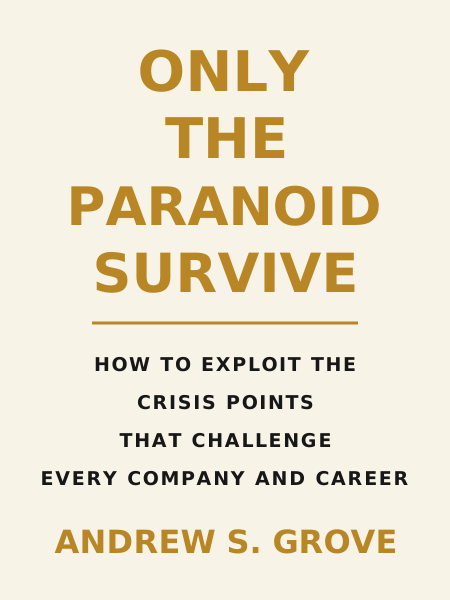
Only the Paranoid Survive
Andrew S. Grove · 1996
Editorial rating
- Evidence
- 8/10
- Actionability
- 6/10
- Originality
- 9/10
The thesis
Every business eventually faces a "strategic inflection point" - a 10X change that transforms the rules of competition overnight. These moments can destroy companies or catapult them to dominance. The leader's job is to detect these shifts early and navigate through the chaos of transformation.
Who this is for
Executives responsible for company strategy, managers sensing that "something has changed" in their industry, and anyone leading through periods of fundamental market disruption.
My favorite quote
A strategic inflection point is a time in the life of a business when its fundamentals are about to change.
Why it matters
This simple definition captures something profound - there are moments when the game itself changes, not just the players.
Do this
Ask your sales team and middle managers: "What are customers telling you that they weren't saying a year ago?" They sense inflection points before executives do.
Start here
Middle managers detect inflection points first: Executives are insulated from reality by layers of filtered information. Salespeople hear customer complaints. Middle managers see both strategic intent and execution reality. Create direct channels to hear from them - the first signals of existential change come from the front lines, not the boardroom.
Critical summary
Grove, who led Intel through its transformation from a memory company to the microprocessor giant, provides a framework for recognizing and navigating industry-shifting change. His central concept - the Strategic Inflection Point (SIP) - occurs when a 10X change in competitive forces fundamentally alters the business landscape.
The book's greatest value is Grove's brutal honesty about Intel's near-death experiences: the memory crisis that nearly bankrupted them, the Pentium bug that threatened their reputation, and the internet's emergence that required yet another reinvention. These aren't sanitized success stories - they're survival tales.
What it gets right
- Framework for detecting existential threats before they become obvious
- Emphasis on listening to front-line employees and middle managers
- Recognition that strategy execution requires letting chaos reign, then reining it in
What it misses
- Heavy focus on semiconductor industry makes some examples feel niche
- Dated technology references (internet as emerging threat) require mental updating
- Doesn't provide a practical checklist - diagnosis is stronger than prescription
- Grove was an exceptional leader; the approach may not transfer to average managers
Evidence is primarily Intel's internal experience, but it's detailed and credible. Grove doesn't hide failures, which makes his insights trustworthy.
Key concepts
Strategic Inflection Point (SIP)
A 10X change in one of the forces affecting your business that fundamentally changes the competitive landscape.
The Six Forces
Porter's five forces plus "complementors" - companies whose products add value to yours (Microsoft for Intel's chips).
Signal vs. Noise
The challenge is distinguishing temporary disruptions from existential shifts. Over-reaction is costly, but under-reaction is fatal.
Let Chaos Reign, Then Rein in Chaos
During inflection points, experimentation must be allowed even when it feels messy. Direction comes after clarity emerges.
The New Company Test
Ask yourself, "If we got kicked out and the board brought in a new CEO, what would they do?" Then do that.
Valley of Death
The dangerous period between recognizing an inflection point and successfully navigating through it.
Core insights
-
Success creates vulnerability
The more successful you are, the harder it is to see that the game is changing. Past success blinds you to future threats.
-
Middle managers know first
Front-line employees and middle managers detect shifts before executives because they're closer to customers and reality.
-
Wait too long and you're dead
Your tendency will always be to wait too long to respond. The consequences of moving early are far less severe than moving late.
-
Clarity of direction beats optimal direction
During chaos, a clear direction - even if imperfect - is better than paralysis waiting for the perfect answer.
-
The rules change, but you might not notice
Strategic inflection points are obvious in hindsight but nearly invisible when they're happening.
Implementation steps
Today
- List the six forces affecting your business and identify which has changed most in the last 3 years
- Ask yourself the "new CEO" question: what would an outsider do?
This week
- Schedule informal conversations with 3 front-line employees - what are they hearing from customers?
- Identify one competitive threat you've been dismissing as "not serious enough"
This month
- Create a "Cassandra" role - someone tasked with finding evidence that your strategy is wrong
- Map your industry's potential 10X changes - new technology, regulatory shifts, competitive entry
Ongoing
- Review your strategic assumptions quarterly - are they still valid?
- Maintain direct information channels from middle management to leadership
Suggested 30-day practice plan
An editorial application plan created by Monolithic Vault - an interpretation of the book's ideas, not part of the original book.
- Day 1
Write down your business's fundamental assumptions - what must remain true for you to succeed?
- Day 2
Identify which of the six forces has changed most recently in your industry
- Day 3
Talk to one salesperson: what objections are they hearing that are new?
- Day 7
Research one emerging competitor or technology you've been ignoring
- Day 14
Present your "what could kill us" analysis to leadership
- Day 21
Identify one strategic experiment you should run to test a new direction
- Day 30
Create a recurring calendar item to revisit your strategic assumptions quarterly
Free PDF summary
Take this analysis with you: a designed two-page field-notes sheet with the thesis, my favorite quote, the key concepts and core insights, and the full 30-day checklist. Print it or keep it - free, no signup.
Go deeper
If this analysis earned your attention, the full book goes further than any summary can. The original is always the primary source.