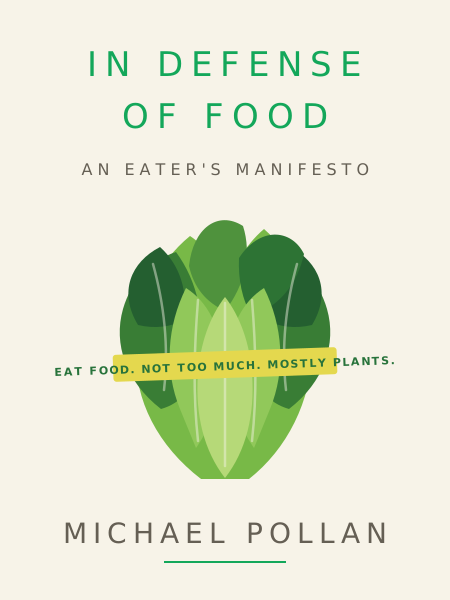
In Defense of Food
Michael Pollan · 2008
Editorial rating
- Evidence
- 8/10
- Actionability
- 9/10
- Originality
- 7/10
The thesis
The Western diet - engineered, processed, reductionist - is making us sick. Escape nutritionism (the ideology that food is reducible to nutrients) and return to real food: whole, recognizable, minimally processed. Eat food. Not too much. Mostly plants.
Who this is for
Anyone confused by conflicting dietary advice, frustrated by processed food dominance, or wanting to escape the cycle of diets and supplements. Particularly useful for people trying to navigate grocery stores without nutrition science degrees.
My favorite quote
Don't eat anything your great-grandmother wouldn't recognize as food.
Why it matters
This simple heuristic cuts through decades of nutritional confusion and marketing jargon - if it didn't exist 100 years ago, it's probably not real food.
Do this
Walk your grocery store's perimeter today (produce, meat, dairy) and avoid the center aisles where processed foods dominate.
Start here
Nutritionism - the ideology that food is just a delivery system for nutrients - is the enemy. Food scientists and marketers have convinced us that we need experts to tell us what to eat, when humans ate perfectly well for millennia without nutritional labels. The solution? Eat real food (things your great-grandmother would recognize), not too much (stop at 80% full), mostly plants (vegetables should dominate your plate). This isn't a diet - it's a return to common sense.
Critical summary
Pollan, a journalist and food systems critic, attacks both the food industry and nutritional science for creating the "American paradox": the more we worry about nutrition, the less healthy we become. His central thesis is that nutritionism - reducing food to its chemical components (vitamins, fats, carbs, antioxidants) - is an ideology masquerading as science, and it has failed spectacularly.
The book is structured in three parts: (1) The Age of Nutritionism (how we got here), (2) The Western Diet and Diseases of Civilization (the health consequences), and (3) Getting Over Nutritionism (what to do about it).
What it gets right
- The Western diet - refined carbs, industrial oils, processed foods, excessive meat - is clearly linked to chronic diseases (heart disease, diabetes, obesity, cancer). Populations eating traditional diets don't suffer these at remotely similar rates.
- Nutritionism creates paralysis and confusion. Labels like "low-fat" and "fortified with vitamins" make industrial food seem healthy when it's not. Margarine (trans fats) was promoted as healthier than butter for decades - disastrously wrong.
- Whole foods contain synergistic compounds that can't be replicated by supplements. An orange is not just vitamin C - it contains flavonoids, fiber, and hundreds of other compounds working together.
- The simplicity of "Eat food. Not too much. Mostly plants" is genuinely liberating after decades of conflicting dietary dogma.
What it misses
- Pollan is better at diagnosis than prescription. The "eat real food" advice is directionally correct but vague. What counts as "real" is culturally specific and often expensive. Farmer's markets and organic produce are luxuries many can't afford.
- Limited discussion of structural barriers: food deserts, time poverty, cooking skill erosion. Telling someone to "shop the perimeter" doesn't help if they live in a neighborhood without a proper grocery store.
- Cherry-picks traditional diets. The Mediterranean and Japanese diets are healthy, but Pollan romanticizes "traditional eating" without acknowledging that many traditional diets were nutritionally deficient (scurvy, rickets, malnutrition were common historically).
- Dismisses nutritional science too broadly. Yes, it's made mistakes (low-fat craze, cholesterol panic), but also delivered genuine wins (iodized salt eliminating goiter, folic acid preventing neural tube defects).
Evidence is primarily epidemiological (populations eating Western diets get sick, populations eating traditional diets don't) and anecdotal. Strong correlations but weaker on mechanisms. He's a journalist, not a scientist - excellent synthesis, less rigorous on causality.
Key concepts
Nutritionism
The ideology that food is reducible to nutrients. Turns eating into a scientific problem requiring expert guidance. Apply: Ignore health claims on packages - they're marketing, not wisdom.
Edible Food-Like Substances
Industrial products engineered to seem like food (Lunchables, Go-Gurt, most breakfast cereals). Apply: If it has more than 5 ingredients or ingredients you can't pronounce, skip it.
The Western Diet
Refined carbs, industrial oils, processed foods, excessive meat, insufficient plants. Apply: Make vegetables the center of your plate, not the side dish.
Food Culture
Traditional eating patterns passed down through generations that kept people healthy without nutrition labels. Apply: Ask yourself "Would my great-grandmother recognize this as food?"
The Omnivore's Dilemma
Humans can eat almost anything, which creates anxiety about what we should eat. Nutritionism exploits this anxiety. Apply: Trust tradition and common sense over marketing claims.
Core insights
-
The more we worry about nutrition, the less healthy we become
The U.S. has the most nutrition-obsessed food culture and the worst health outcomes. Correlation isn't causation, but nutritionism clearly hasn't helped.
-
Food science mostly serves the food industry, not human health
"Low-fat" products replaced fat with sugar. "Heart-healthy" margarine contained trans fats. Science was corrupted by corporate funding.
-
You don't need to understand biochemistry to eat well
Humans thrived for millennia without knowing what an antioxidant was. Cultural wisdom encoded in traditional diets worked - and still works.
-
Shop the perimeter, avoid the middle
Grocery stores are designed to maximize processed food sales. Real food (produce, meat, dairy) lives on the edges. The center aisles are nutritionism's cathedral.
-
Cooking is the most important food skill you can reclaim
If you cook, you automatically avoid most processed food. It's harder to eat badly when you're starting with raw ingredients.
Implementation steps
Today
- Audit your pantry: count how many items have more than 5 ingredients
- Plan one meal using only whole, recognizable ingredients (roasted chicken, steamed vegetables, rice)
This week
- Shop the perimeter of your grocery store - avoid center aisles entirely for one shopping trip
- Cook at least 4 dinners at home using Pollan's rules (no more than 5 ingredients per item, nothing you can't pronounce)
- Try one farmers market visit if accessible
This month
- Eliminate one category of processed food (soda, packaged snacks, frozen meals)
- Learn to cook 3 simple, whole-food meals you can make in under 30 minutes
- Practice the 80% full rule (hara hachi bu) - stop eating before you're stuffed
Ongoing
- Default to plants: make vegetables the center of your plate, not an afterthought
- Ask the great-grandmother test before buying: "Would she recognize this as food?"
- Cook more than you eat out - this single habit change solves most dietary problems
Suggested 30-day practice plan
An editorial application plan created by Monolithic Vault - an interpretation of the book's ideas, not part of the original book.
- Day 1
Read nutrition labels on everything in your pantry, note ingredient counts
- Day 2
Shop only the perimeter of grocery store, buy nothing from center aisles
- Day 3
Cook a simple whole-food dinner (protein, vegetable, whole grain)
- Day 7
Eliminate soda and sweetened beverages completely
- Day 10
Visit a farmers market or farm stand if available
- Day 14
Cook at least 5 dinners at home this week, track how you feel
- Day 21
Try a traditional cuisine meal (Mediterranean, Japanese, Mexican) with mostly plants
- Day 30
Audit your diet - what percentage is whole foods vs. processed? Celebrate wins, identify one more area to improve
Free PDF summary
Take this analysis with you: a designed two-page field-notes sheet with the thesis, my favorite quote, the key concepts and core insights, and the full 30-day checklist. Print it or keep it - free, no signup.
Go deeper
If this analysis earned your attention, the full book goes further than any summary can. The original is always the primary source.