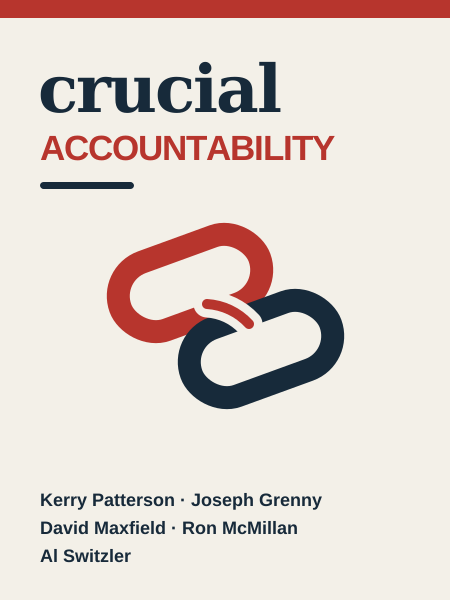
Crucial Accountability
Kerry Patterson, Joseph Grenny, David Maxfield, Ron McMillan, Al Switzler · 2013
Editorial rating
- Evidence
- 6/10
- Actionability
- 8/10
- Originality
- 5/10
The thesis
When someone fails to meet a commitment - a broken promise, missed deadline, or violated expectation - you face a choice: let it slide (and enable the behavior), or hold them accountable (and risk the relationship). This book provides a framework for the second option that preserves dignity while demanding performance.
Who this is for
Managers who avoid difficult conversations about performance, team leads whose standards keep slipping because no one addresses failures, and anyone who has ever thought "I should say something" and didn't.
My favorite quote
At the heart of most chronic problems lies a crucial accountability conversation that has either never been held or has been held badly.
Why it matters
This connects ongoing frustrations to a specific, actionable conversation you're avoiding.
Do this
Identify one chronic problem on your team. What conversation haven't you had?
Start here
Before any accountability conversation, diagnose the gap: Is this a motivation problem (they don't want to), an ability problem (they can't), or both? Each requires different intervention. If they lack motivation, explore incentives and consequences. If they lack ability, provide training, resources, or support. Treating ability problems as motivation problems (or vice versa) makes things worse.
Critical summary
The VitalSmarts team (authors of Crucial Conversations) wrote this follow-up focused specifically on holding people accountable for commitments. The book addresses the gap between expectations and performance - the moments when someone says "I will" and then doesn't.
The methodology builds on their earlier work but focuses on post-failure conversations: What do you say when someone has already let you down? How do you address the pattern without damaging the relationship?
What it gets right
- The motivation/ability diagnostic is genuinely useful
- Scripts for difficult conversations are practical
- Addresses the "but what if they get defensive?" concern
- Distinguishes between content (this instance), pattern (recurring), and relationship (trust) levels
- Strong emphasis on safety and mutual respect
What it misses
- Significant overlap with Crucial Conversations - feels like an extension, not a new framework
- Can feel formulaic; real conversations are messier
- Written in a corporate-training style that some find dry
- The acronyms and frameworks multiply quickly
- Less applicable to peer or upward accountability
- Limited discussion of when to give up and manage someone out
The book is most useful as a companion to Crucial Conversations for managers specifically dealing with performance issues.
Key concepts
The Accountability Discussion
The conversation you have when someone fails to meet a commitment. Not about blame; about understanding and correction.
Motivation vs. Ability
Two different causes of gaps. Motivation = they don't want to. Ability = they can't. Diagnose before intervening.
Content, Pattern, Relationship
Three levels to address. Content = this specific instance. Pattern = this keeps happening. Relationship = I can't trust you.
CPR
Choose which level to address. C = Content (first time). P = Pattern (recurring). R = Relationship (trust breakdown).
Natural Consequences
Instead of threats, help them see the real consequences of their behavior on themselves, others, and the organization.
Make It Safe
Without psychological safety, accountability conversations fail. Establish mutual respect and mutual purpose first.
Core insights
-
Address it or enable it
Silence is permission. When you don't address a failure, you've tacitly approved it.
-
Choose the right CPR level
First-time issues need content conversations. Recurring issues need pattern conversations. Trust erosion needs relationship conversations.
-
Start with yourself
Before blaming, ask: Did I set clear expectations? Did I provide necessary resources? Am I part of the problem?
-
Diagnose before prescribing
Motivation solutions fail for ability problems. Training fails for motivation problems. Figure out which it is first.
-
Consequences, not threats
Help them see the natural impact of their choices. "When you miss deadlines, the team has to scramble" is different from "If you miss another deadline, you're fired."
Implementation steps
Today
- Identify one unaddressed accountability issue on your team
- Diagnose: Is it motivation, ability, or both?
This week
- Choose the appropriate CPR level for the conversation
- Script the opening: Start with facts, not accusations
This month
- Have the conversation; focus on mutual purpose ("I want you to succeed")
- After the conversation, document agreements and follow-up dates
Ongoing
- When commitments are made, clarify who does what by when
- Address issues early (content level) before they become patterns
Suggested 30-day practice plan
An editorial application plan created by Monolithic Vault - an interpretation of the book's ideas, not part of the original book.
- Day 1
List all unaddressed accountability issues; prioritize by impact
- Day 2
For the top issue, diagnose: motivation, ability, or both?
- Day 3
Determine the CPR level (content, pattern, or relationship)
- Day 7
Script your opening; practice with a colleague
- Day 14
Have the conversation; document agreements
- Day 21
Follow up on commitments made during the conversation
- Day 30
Assess: Has behavior changed? What's the next accountability gap to address?
Free PDF summary
Take this analysis with you: a designed two-page field-notes sheet with the thesis, my favorite quote, the key concepts and core insights, and the full 30-day checklist. Print it or keep it - free, no signup.
Go deeper
If this analysis earned your attention, the full book goes further than any summary can. The original is always the primary source.