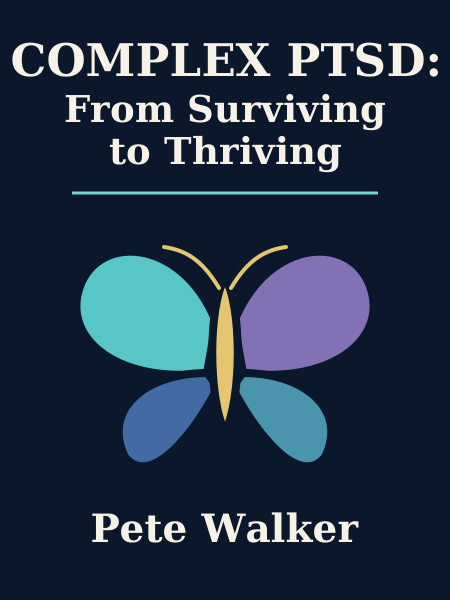
Complex PTSD
Pete Walker · 2013
Editorial rating
- Evidence
- 7/10
- Actionability
- 9/10
- Originality
- 8/10
The thesis
Complex PTSD (C-PTSD) isn't just PTSD - it's the result of prolonged childhood emotional abuse or neglect that creates emotional flashbacks, toxic shame, and a vicious inner critic. Recovery requires grieving childhood losses, shrinking the critic, and learning self-compassion you were never taught.
Who this is for
Survivors of childhood emotional neglect or abuse, therapists working with developmental trauma, and anyone battling perfectionism, chronic shame, or unexplained relationship difficulties rooted in family-of-origin trauma.
My favorite quote
Perfectionism is the unparalleled defense for emotionally abandoned children. The existential unattainability of perfection saves the child from giving up, unless or until scant success forces retreat into dissociative depression.
Why it matters
This explains why so many high-achievers secretly feel broken - perfectionism isn't ambition, it's a survival strategy from childhood that now sabotages adult thriving.
Do this
Notice when your inner critic attacks you today. Respond with: "I am learning to treat myself with kindness" (Walker's reparenting affirmation). Repeat until it feels less foreign.
Start here
Emotional flashbacks are the core symptom of C-PTSD - sudden, overwhelming feelings of shame, fear, or worthlessness triggered by present-day events but rooted in childhood trauma. Unlike PTSD flashbacks (visual/sensory re-experiencing), emotional flashbacks have no images - just crushing feelings that seem to come from nowhere. Learning to identify and manage flashbacks is the gateway to recovery. Walker's 13-step flashback management protocol (Chapter 8) is the most actionable trauma tool you'll find anywhere.
Critical summary
Walker is a therapist who spent 30+ years treating childhood trauma survivors and writes from his own recovery experience. The book synthesizes attachment theory, trauma neurobiology, and practical coping tools into a recovery roadmap. Unlike academic trauma texts, this is explicitly a self-help guide - dense with exercises, affirmations, and step-by-step protocols.
Core framework: C-PTSD develops when children face ongoing abuse/neglect without safe attachment figures. The child internalizes parental criticism as an "Inner Critic" and develops one of four survival responses: Fight (anger/control), Flight (perfectionistic overachievement), Freeze (dissociation/isolation), or Fawn (people-pleasing/codependency). These "4F" responses become maladaptive in adulthood.
Recovery path: (1) Understand the origins of C-PTSD, (2) Identify and shrink the inner critic, (3) Manage emotional flashbacks, (4) Grieve childhood losses, (5) Build self-compassion, (6) Develop healthy relationships.
What it gets right
- Fills a gap: Before this book, C-PTSD was under-recognized. Walker made it accessible to survivors outside therapy.
- Actionable protocols: 13 steps for managing flashbacks, specific affirmations for reparenting, concrete guidance on shrinking the critic.
- 4F Typology: Fight/Flight/Freeze/Fawn framework helps survivors understand their coping patterns and triggers.
- Compassionate tone: Walker writes like a loving therapist. Many readers report feeling "seen" for the first time.
- Integration of theory and practice: Blends neurobiology, attachment theory, and CBT into usable tools.
What it misses or overstates
- Forgiveness skepticism: Walker is critical of "forgive and forget" pressure, which is valid - but some readers feel he overemphasizes anger work. Forgiveness can be healing when chosen freely, not coerced.
- Repetitive: Similar concepts explained multiple times across chapters. Could be 200 pages instead of 350.
- Limited research citations: Relies heavily on clinical experience rather than peer-reviewed studies. Not academic rigor, but clinically grounded.
- Angry at parents: Goodreads reviewers note Walker encourages directing anger at abusive parents as healing. Some readers find this helpful; others feel it keeps them stuck in blame.
- U.S./Western-centric: Assumes individualistic culture. Collectivist cultures may find the "set boundaries with family" advice culturally incompatible.
Evidence quality: Moderate. Walker cites some attachment research (Bowlby, Ainsworth) and trauma neuroscience (van der Kolk), but mostly draws from 30 years of clinical practice. It's "me-search" masquerading as research - his personal recovery informs every page. For survivors, this is a feature (relatable), not a bug. For skeptics, it's weak on scientific backing.
Critical reception: Transformative for many. Goodreads 4.34/5 (25,000+ ratings). Reddit r/CPTSD considers it essential. Criticized by some therapists for oversimplifying complex trauma and encouraging self-diagnosis. Praised by others for making trauma work accessible. Reading it can be triggering - many readers report needing breaks.
Key concepts
Emotional Flashbacks
Sudden regression to overwhelming childhood feelings (fear, shame, abandonment) without visual/sensory memories. Triggered by present events (criticism, rejection, failure) that echo childhood dynamics. Learn Walker's 13 steps (say to yourself: "I am having a flashback," ground in present, practice self-compassion).
The Inner Critic
An internalized voice of parental criticism that attacks you constantly. In C-PTSD, it's not just negative self-talk - it's a dominating neural network that programs self-hatred. Shrink it by: (1) Recognizing its voice, (2) Talking back ("You're not helping"), (3) Replacing with self-compassion.
The 4F Responses
Fight (anger, control, blaming), Flight (perfectionism, workaholism, panic), Freeze (dissociation, isolation, numbness), Fawn (people-pleasing, codependency). Most people have a primary type with secondary. Identify yours to understand triggers and relational patterns.
Toxic Shame
Belief that you are fundamentally defective, unlovable, or worthless. Imposed by caregivers who shamed authentic self-expression. Combat with: self-compassion practice, grieving losses, challenging critic, seeking safe relationships.
Reparenting
Giving yourself the love, validation, and protection you never received as a child. Walker provides affirmations: "I am so glad you were born," "You can come to me when you're hurt," "I love who you are."
Grieving Childhood Losses
C-PTSD survivors often minimize childhood trauma ("others had it worse"). Recovery requires acknowledging and mourning what you didn't get - safety, attunement, unconditional love, protection. Crying is healing.
Core insights
-
"Children who receive good enough parenting easily recognize and protect themselves from bullying because they don't have to become accustomed to being treated unfairly"
If you tolerate mistreatment in adult relationships, it's often because childhood normalized it.
-
"Fawn types seek safety by merging with others' wishes, forfeiting all their own needs, rights, and boundaries"
People-pleasing isn't kindness - it's a survival strategy learned from narcissistic or demanding parents. Recovery means learning to disappoint people without collapsing.
-
"Perfectionism is not about excellence - it's about avoiding abandonment"
If failure feels catastrophic, you're probably in a flashback to childhood when mistakes triggered parental rage or withdrawal.
-
"The most expeditious way past an unpleasant emotion is to embrace it and fully feel and express it"
Dissociation and avoidance prolong suffering. Crying, anger, fear - when felt fully - discharge and resolve.
-
"We must redirect blame to our parents' dreadful child-rearing practices"
Controversial, but Walker argues taking childhood trauma off yourself ("I deserved it," "I was difficult") is essential before you can consider parents' mitigating circumstances.
-
"Recovering depends on using mindfulness to decrease dissociation"
Trauma survivors live in their heads, disconnected from body/emotions. Mindfulness practice reconnects you to the present and to your feelings.
-
"Many freeze types unconsciously believe people are dangerous and safety lies in solitude"
The most profoundly abandoned children retreat into isolation, mistaking loneliness for safety. Recovery requires gradual re-engagement with safe people.
Implementation steps
Today
- Read Walker's 13 Steps for Managing Emotional Flashbacks (Chapter 8, or find online). Print it, keep it accessible.
- Next time you feel sudden shame, fear, or worthlessness, say out loud: "I am having a flashback. This is not happening now."
This week
- Identify your 4F type (Fight, Flight, Freeze, or Fawn). Read the corresponding chapter. Notice patterns in your relationships and reactions.
- Begin Walker's "Shrinking the Inner Critic" practice: When the critic attacks, respond with thought-stopping ("Stop!") then self-compassion ("I'm doing my best").
- Start a feelings journal: What emotions arose today? What triggered them? No analysis, just naming.
This month
- Commit to grieving work: Spend 20 minutes weekly crying, writing, or talking about what you didn't get in childhood (safety, attunement, validation). Let yourself feel the loss.
- Practice reparenting affirmations daily (see book or create your own). Example: "I am so glad you exist. You are lovable as you are."
- Seek therapy if not already in it - preferably trauma-focused (EMDR, IFS, somatic therapists who understand C-PTSD). Self-help is necessary, not sufficient.
Ongoing
- Build a "safe enough" relationship - friend, therapist, partner - where you can practice vulnerability without punishment. Relationships heal relational wounds.
- Continue shrinking the critic. It won't disappear, but you can reduce it from dominating voice to occasional annoyance.
- When triggered, return to flashback management steps. Recovery isn't linear - flashbacks will happen. Managing them gets easier.
Suggested 30-day practice plan
An editorial application plan created by Monolithic Vault - an interpretation of the book's ideas, not part of the original book.
- Day 1
Read Complex PTSD (or at minimum, Chapters 1, 8, and your 4F type chapter). Understand the framework.
- Day 3
Identify your primary 4F response. Journal about how it shows up in relationships, work, conflict.
- Day 5
Memorize Walker's 13 Steps for Flashback Management. Next flashback, use them.
- Day 7
Begin daily reparenting affirmations. Set phone reminder. Say them even if they feel absurd.
- Day 10
Grief session #1 - cry, write, or talk about one thing you didn't get as a child. Let yourself feel it.
- Day 14
Mid-point check - are you noticing flashbacks earlier? Is the critic quieter? Small progress counts.
- Day 17
Grief session #2 - another childhood loss. Anger or sadness, both are valid.
- Day 21
Practice setting a boundary with someone (even small: "I can't do that right now"). Notice if you collapse into Fawn response or manage to hold it.
- Day 28
Grief session #3. By now, crying should feel slightly more natural, less scary.
- Day 30
Reflect - write a letter to your younger self expressing compassion for what they endured. This is reparenting.
Free PDF summary
Take this analysis with you: a designed two-page field-notes sheet with the thesis, my favorite quote, the key concepts and core insights, and the full 30-day checklist. Print it or keep it - free, no signup.
Go deeper
If this analysis earned your attention, the full book goes further than any summary can. The original is always the primary source.