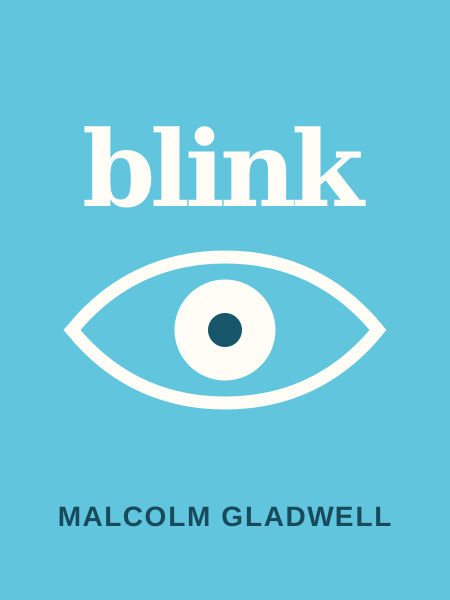
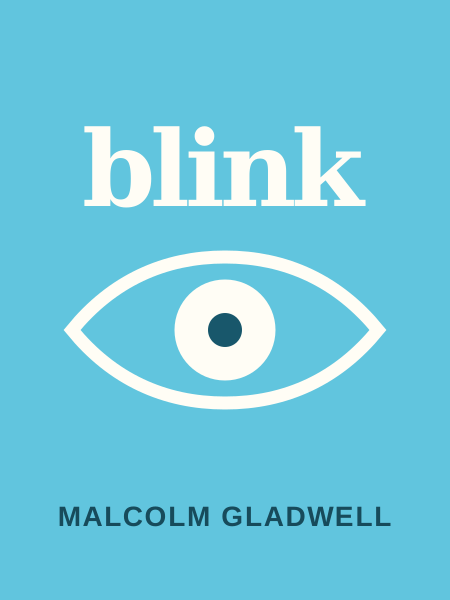
Blink
Malcolm Gladwell · 2005
Editorial rating
- Evidence
- 5/10
- Actionability
- 4/10
- Originality
- 7/10
The thesis
Snap judgments made in the "blink" of an eye can be just as good as - or better than - carefully deliberated decisions. Our unconscious mind rapidly processes information through "thin-slicing," and experts can make remarkably accurate assessments with minimal data. But this same system is vulnerable to bias and can fail catastrophically under stress.
Who this is for
Decision-makers who want to understand when to trust their gut and when to slow down. Useful for hiring managers, investors, negotiators, and anyone who makes high-stakes judgments - but primarily as a cautionary tale about unconscious bias.
My favorite quote
There can be as much value in the blink of an eye as in months of rational analysis.
Why it matters
It validates intuition in an over-analytical world, but the key word is "can" - Gladwell's examples show when it works AND when it fails disastrously.
Do this
Before your next important decision, write down your instant gut reaction. Then do your analysis. Compare - when do they align? When do they diverge?
Start here
Recognize that your unconscious mind is constantly "thin-slicing" - extracting patterns from minimal information. This works brilliantly when you have genuine expertise in a domain (art authentication, marriage counseling, tennis coaching). It fails when you lack expertise, when you're under extreme stress, or when unconscious biases contaminate the process. The skill isn't "trust your gut" - it's knowing which situations warrant gut trust.
Critical summary
Gladwell, the master of pop psychology narrative, weaves together compelling stories about rapid cognition. The Getty kouros statue that experts instantly sensed was fake. John Gottman predicting divorce with 90% accuracy from 15 minutes of conversation. Speed-dating patterns. Police shootings gone wrong.
What it gets right
- The concept of "thin-slicing" is legitimate and backed by psychology research
- Gottman's marriage research is genuinely impressive and well-documented
- The book acknowledges that rapid cognition can fail spectacularly (Amadou Diallo shooting)
- Gladwell's storytelling makes complex psychology accessible
What it misses or overstates
- Doesn't provide a framework for knowing WHEN to trust intuition vs. deliberate analysis
- The book contradicts itself - celebrates snap judgments, then shows how they cause racist police shootings
- Expertise is a precondition for good thin-slicing, but this isn't emphasized enough
- Little practical guidance - it's descriptive, not prescriptive
- Critics note Gladwell doesn't explain HOW the brain does this; it's more "isn't this cool" than rigorous analysis
- Some examples feel cherry-picked; confirmation bias in storytelling
Evidence quality: Gladwell draws on legitimate research (Gottman, implicit association tests, facial recognition studies) but oversimplifies and rarely engages with contradictory evidence. The anecdotes are compelling but don't constitute proof. As one critic noted: "Good dinner party conversation, but not a fully developed argument." Daniel Kahneman's Thinking, Fast and Slow covers similar territory with far more rigor.
Key concepts
Thin-Slicing
The ability to find patterns and make judgments from a narrow slice of experience. Works best with expertise; dangerous without it.
The Adaptive Unconscious
Mental processes that operate automatically and rapidly, outside conscious awareness. Similar to Kahneman's "System 1."
The Four Horsemen
Gottman's predictors of divorce - contempt, criticism, defensiveness, stonewalling. Contempt is the most lethal.
Verbal Overshadowing
Trying to articulate why you made a judgment can actually make future judgments worse. Sometimes analysis interferes with intuition.
Priming
Unconscious cues that alter behavior. Being exposed to words about old age makes you walk slower. Environment shapes snap judgments.
Mind Reading
The ability to read emotions from faces and body language. Can be trained but also contaminated by bias.
Core insights
-
Expertise enables good snap judgments
Experts can thin-slice effectively because their unconscious has been trained by thousands of hours of deliberate practice. Without expertise, gut reactions are just biases.
-
Contempt predicts relationship doom
Of Gottman's Four Horsemen, contempt is the deadliest - it signals fundamental disrespect and predicts divorce better than any other factor.
-
Too much information can hurt
In some contexts, more data doesn't improve decisions - it just adds noise. Doctors using fewer data points sometimes diagnose heart attacks more accurately.
-
Stress destroys thin-slicing
Under extreme stress (heart rate >145 bpm), the adaptive unconscious fails. This explains why police shootings of unarmed people happen - tunnel vision, automatic responses, loss of nuance.
-
Unconscious bias is real and measurable
The Implicit Association Test reveals biases we don't consciously hold but that influence snap judgments. Knowing this doesn't automatically fix it.
Implementation steps
Today
- Take an Implicit Association Test at implicit.harvard.edu to discover your unconscious biases
- Recall a recent snap judgment. What information did you actually use? What did you ignore?
This week
- In one meeting, note your first impression of an idea before discussion. Track how often your initial reaction proves right.
- Practice recognizing the Four Horsemen (contempt, criticism, defensiveness, stonewalling) in conversations around you.
This month
- Identify domains where you have genuine expertise. In these areas, experiment with trusting your initial instincts more.
- In areas where you lack expertise, deliberately slow down and seek more data before deciding.
Ongoing
- Build expertise in domains that matter to you - that's what enables reliable thin-slicing
- Create structures (blind auditions, structured interviews) to reduce bias in important decisions
- Under stress, force yourself to slow down - your thin-slicing system is compromised
Suggested 30-day practice plan
An editorial application plan created by Monolithic Vault - an interpretation of the book's ideas, not part of the original book.
- Day 1
Take 2-3 Implicit Association Tests. Document your results without judgment.
- Day 3
Watch a conversation between two people. Try to predict their relationship quality using only body language and tone.
- Day 7
Review a past decision where you trusted your gut. Was it a domain of expertise? Did it work out?
- Day 14
Implement one "blind" process in your work (anonymized resume review, removing names from proposals before evaluation).
- Day 21
Practice recognizing when you're under stress (elevated heart rate, tunnel vision). These are signals to slow down, not speed up.
- Day 30
Create your personal framework: "I thin-slice in [domains with expertise]. I deliberate in [domains without expertise]."
Free PDF summary
Take this analysis with you: a designed two-page field-notes sheet with the thesis, my favorite quote, the key concepts and core insights, and the full 30-day checklist. Print it or keep it - free, no signup.
Go deeper
If this analysis earned your attention, the full book goes further than any summary can. The original is always the primary source.