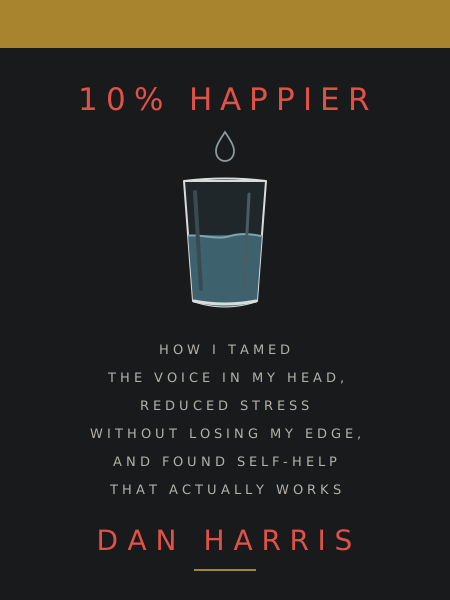
10% Happier
Dan Harris · 2014
Editorial rating
- Evidence
- 8/10
- Actionability
- 9/10
- Originality
- 7/10
The thesis
Meditation isn't mystical woo-woo for hippies - it's a scientifically validated tool that rewires your brain to be less reactive, more focused, and genuinely happier. A skeptical, neurotic news anchor had a panic attack on live TV, discovered meditation, and became 10% happier. If it works for him, it can work for anyone.
Who this is for
Skeptics who think meditation is too "spiritual," high-achievers worried that meditation will dull their competitive edge, and anyone dealing with anxiety, overthinking, or the relentless voice in their head.
My favorite quote
The voice in my head can be a total asshole.
Why it matters
This blunt acknowledgment captures the inner critic most people live with but rarely name. Meditation teaches you to recognize that voice isn't you - it's just noise you can observe.
Do this
Next time your inner voice starts catastrophizing or criticizing, mentally label it "thinking" and return your attention to your breath. That's it. That's meditation.
Start here
Meditation is not about clearing your mind - that's impossible. It's about noticing when your mind wanders (to anxiety, planning, rumination) and gently returning focus to your breath. This simple act, repeated thousands of times, rewires your brain's default mode network, making you less reactive and more present. Start with 5 minutes daily. One minute counts. Harris's "10%" framing is perfect: meditation won't solve all your problems, but it's a significant, measurable improvement for minimal time investment.
Critical summary
Harris, a co-anchor on ABC's Nightline, had a panic attack on live television in 2004 - heart racing, mind blanking, sweating - in front of 5 million viewers. The panic attack was the culmination of years covering war zones (Iraq, Afghanistan), depression he didn't recognize, and self-medicating with cocaine and ecstasy. A doctor told him his drug use (even though intermittent) had raised baseline anxiety enough to trigger the on-air meltdown.
The book chronicles Harris's journey from that panic attack to discovering meditation through his beat covering religion and spirituality for ABC. He was deeply skeptical - meditation felt like "hippie nonsense" - but the science convinced him: meditation lowers blood pressure, boosts immune function, and rewires brain regions linked to stress, focus, and compassion.
What it gets right
- Meditation for skeptics: Harris is the perfect guide because he was hostile to meditation initially. His secular, science-first framing makes it accessible to people allergic to spiritual jargon. No incense required.
- The voice in your head is not you: This is the core insight. Most people identify completely with their thoughts. Meditation creates distance - you observe thoughts rather than being owned by them. Game-changing for anxiety and rumination.
- You don't need to be calm to meditate: Meditation isn't about achieving a blissful state. It's about noticing when you're distracted (constantly) and returning to the present. The repetition is what rewires your brain.
- Science backs it up: Harris cites neuroscience showing meditation physically changes brain structure - thickening the prefrontal cortex (executive function), shrinking the amygdala (fear response), and improving connectivity in attention networks.
- It doesn't make you soft: Harris worried meditation would kill his competitive edge. Instead, he became more effective - less reactive, better decisions, more focus. The Stoics and samurai meditated; it's not incompatible with ambition.
What it misses
- Privilege blind spot: Harris had access to elite meditation teachers (Joseph Goldstein, Sharon Salzberg) through his job at ABC. Most people don't have that. He nods to apps and books, but the journey feels rarified.
- Underemphasizes consistency difficulty: "Just do 5 minutes daily" sounds easy but isn't. Habit formation is hard. Harris is honest about his struggles but doesn't dive deep into tactics for making meditation stick.
- The 10% framing can undersell it: For some people, meditation is transformative - way more than 10% happier. For others, it does little. Mileage varies more than the title suggests.
- Light on technique: The book is memoir-heavy, instruction-light. You get the "why" but not enough "how." His follow-up, Meditation for Fidgety Skeptics, addresses this better.
Evidence quality is strong for basic meditation benefits (stress reduction, attention improvement, emotional regulation). More speculative for advanced claims (enlightenment, ego dissolution). Harris is good at separating hype from science.
Key concepts
The Voice in Your Head
The nonstop internal narrator criticizing, planning, ruminating, catastrophizing. Meditation helps you see it's not you - it's just mental noise. Apply: Label thoughts as "thinking" when they arise.
Mindfulness
Paying attention to the present moment without judgment. Not a state to achieve but a skill to practice. Apply: Notice sensations while eating, walking, or showering instead of autopiloting.
The Monkey Mind
Buddhist term for the restless, undisciplined mind that jumps from thought to thought. Everyone has it. Apply: Don't fight it - just notice when the monkey is swinging and return to breath.
Non-Judgmental Awareness
Observing thoughts and emotions without labeling them "good" or "bad." This creates space between stimulus and response. Apply: When angry, note "anger arising" instead of immediately reacting.
Responding vs. Reacting
Reacting is automatic, driven by emotion. Responding is intentional, informed by awareness. Meditation builds this gap. Apply: Pause 3 seconds before replying to provocative emails.
Core insights
-
Meditation is not about stopping thoughts - it's about noticing them
The goal isn't a blank mind (impossible). The goal is recognizing when you're lost in thought and returning to the present. That repetition is the workout.
-
Your emotional reactions are optional
Between stimulus and response, there's a gap. Meditation widens that gap. You still feel anger, anxiety, craving - but you're not immediately hijacked by them.
-
One minute counts
Harris's mantra. Perfect is the enemy of good. Five minutes is better than zero. Even one deep breath is better than none. Lower the bar to actually do it.
-
It's not woo-woo, it's neuroscience
Meditation physically changes your brain. fMRI studies show it. Skeptics can trust the science without buying into Buddhism.
-
You don't lose your edge - you sharpen it
Meditation doesn't make you passive. It makes you strategic. Less reactive, more intentional. Stoics, samurai, and Navy SEALs all meditate.
Implementation steps
Today
- Set a timer for 5 minutes. Sit. Focus on your breath. When your mind wanders (it will), notice it and return to breath. Repeat.
- Download a meditation app (10% Happier, Calm, Headspace, Insight Timer) for guided sessions
This week
- Meditate daily for 5 minutes minimum (same time, same place, to build habit)
- When stressed or angry, pause and take 3 conscious breaths before responding
- Notice how often your mind is either in the past (ruminating) or future (planning) vs. present
This month
- Increase meditation to 10 minutes daily
- Attend one in-person or virtual meditation group (accountability and community help)
- Read one meditation technique book or take a beginner course (MBSR, Vipassana, etc.)
Ongoing
- Meditate daily, ideally 10-20 minutes (but "daily-ish" and "one minute counts" are Harris's caveats)
- Practice informal mindfulness: eat one meal per day without screens, walk without headphones, shower with full attention
- Treat meditation as mental hygiene - like brushing your teeth, but for your brain
Suggested 30-day practice plan
An editorial application plan created by Monolithic Vault - an interpretation of the book's ideas, not part of the original book.
- Day 1
Set up meditation corner (cushion, timer, quiet space). Meditate 5 minutes.
- Day 2
Notice the voice in your head narrating your day - just observe it
- Day 3
Meditate 5 minutes. When distracted, label it "thinking" and return to breath
- Day 7
Congratulations - you've meditated 7 days. Track how you feel: more calm? More focused?
- Day 10
Try a guided meditation on an app (different teacher, different approach)
- Day 14
Two weeks in. Notice one situation where you responded instead of reacted.
- Day 21
Increase to 10 minutes daily if 5 feels comfortable. Stick with 5 if not.
- Day 30
Reflect: Are you 10% happier? More patient? Less hijacked by anxiety? Celebrate progress, commit to next 30 days.
Free PDF summary
Take this analysis with you: a designed two-page field-notes sheet with the thesis, my favorite quote, the key concepts and core insights, and the full 30-day checklist. Print it or keep it - free, no signup.
Go deeper
If this analysis earned your attention, the full book goes further than any summary can. The original is always the primary source.